Skip to content

100+ organisations call for a more ambitious budget for culture in AgoraEU

CAE joins a coalition of 100+ cultural organisations, networks, and institutions from across Europe in calling on EU policymakers to ensure a stronger budget for the Culture strand in AgoraEU.

A Sector Contribution to the Work Plan for Culture 2027–2030

Ahead of the next EU Work Plan for Culture, Culture Action Europe has developed a set of recommendations for the Council of the EU, shaped by discussions from the BEYOND Satellites 2026.

The Council’s MFF budget proposal: bad news for AgoraEU

The Council has unveiled its proposed budget allocations for the next long-term EU budget and it’s bad news: a 33% reduction in budget for AgoraEU compared to the Parliament’s position.

Reading between the strands: AgoraEU after Parliament and Council

Culture Action Europe calls for an AgoraEU that covers all cultural and creative sectors fairly, protects the cross-sectoral nature of European cultural cooperation, and provides more ambitious funding for culture as a whole.

EU leaders sign ambitious Joint Declaration on Culture

EU institutions have signed the Joint Declaration on culture, agreeing a long-term strategic vision for culture at the heart of Europe.

Culture is being erased from EU research and innovation funding. How do we save it?

A coalition of cultural networks started the ‘Name, Place, Fund’ campaign to secure the presence of culture for research, innovation and competitiveness in the 2028-2034 budget.

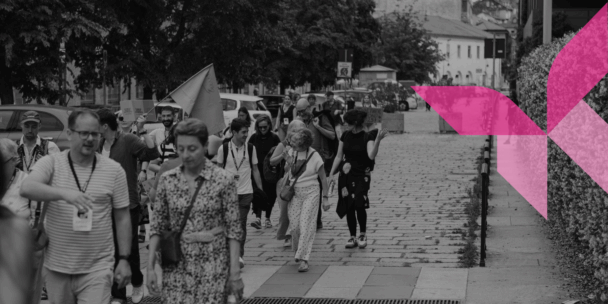
A black-and-white photograph shows a diverse group of people walking down a paved, cobblestone European street or pedestrian walkway lined with trees and buildings. Some individuals are talking and smiling, and a person in the background holds up a light-colored flag. A stylized, bright pink geometric butterfly graphic is overlaid on the right side of the image, contrasting with the monochrome scene.
Title slide: 'A sector contribution to the work plan for culture 2027–2030,' with the Culture Action Europe logo and a black-and-white illustration of flowers, roots, and insects.
An elevated, high-angle view of the image shows a large, circular conference hall with wooden flooring and multiple tiers of seating where numerous people are seated at desks equipped with monitors. A giant, ring-shaped light fixture hangs from the concentric wooden ceiling directly over the center of the room. Digital display screens are mounted on the upper wooden walls, overlooking the formal meeting of the European Council.
Abstract, glowing ring of light with radiating orange, blue, and yellow streaks against a black background.
European leaders Roberta Metsola, Nikos Christodoulides, and Ursula von der Leyen stand side-by-side smiling while jointly holding a dark blue document folder embossed with the European Union stars. They are formally dressed and positioned in front of a backdrop featuring several large European Union flags.

The 4thUnited Cities and Local Government (UCLG) Culture Summit took place on 9-11 of September 2021 in Izmir, Turkey. Under the title “Culture: Shaping the future”, stakeholders of the cultural sectors convened together with mayors and local leaders, academics, activists, and representatives of civil society organizations to discuss the contribution of culture to sustainable development. 

European cultural community mobilises to bring underrepresented voices to the Conference on the Future of Europe 7 September 2021 marks the public launch of “Amplify: Make the Future of Europe Yours”, a public campaign led by Culture Action Europe together with its members in 12 European countries. The launch will begin with online press-conference scheduled … Continued

The UCLG Culture Summit is the main meeting point at global level of cities, local governments and other stakeholders that are committed to the effective implementation of policies and programmes on culture and sustainability. Since 2015, UCLG has convened three editions of the UCLG Culture Summit, which were respectively hosted by the City of Bilbao (Basque Country, Spain, … Continued

“We must improve the status of the artists and their social protection, and address the unequal distribution of value between creators and digital platforms. Working conditions of artists and cultural workers should be on top of the priorities of public institutions as they start implementing measures to recover from the pandemic”-, UNESCO Director General Audrey … Continued

Intersectional gender gap persists in almost all cultural and creative sectors, with cultural professionals  experiencing discrimination based on their gender identities. Female artists and cultural workers across the EU typically have less access to creation and production resources, are paid much less than men and are underrepresented in leadership and other decision-making positions, as well … Continued