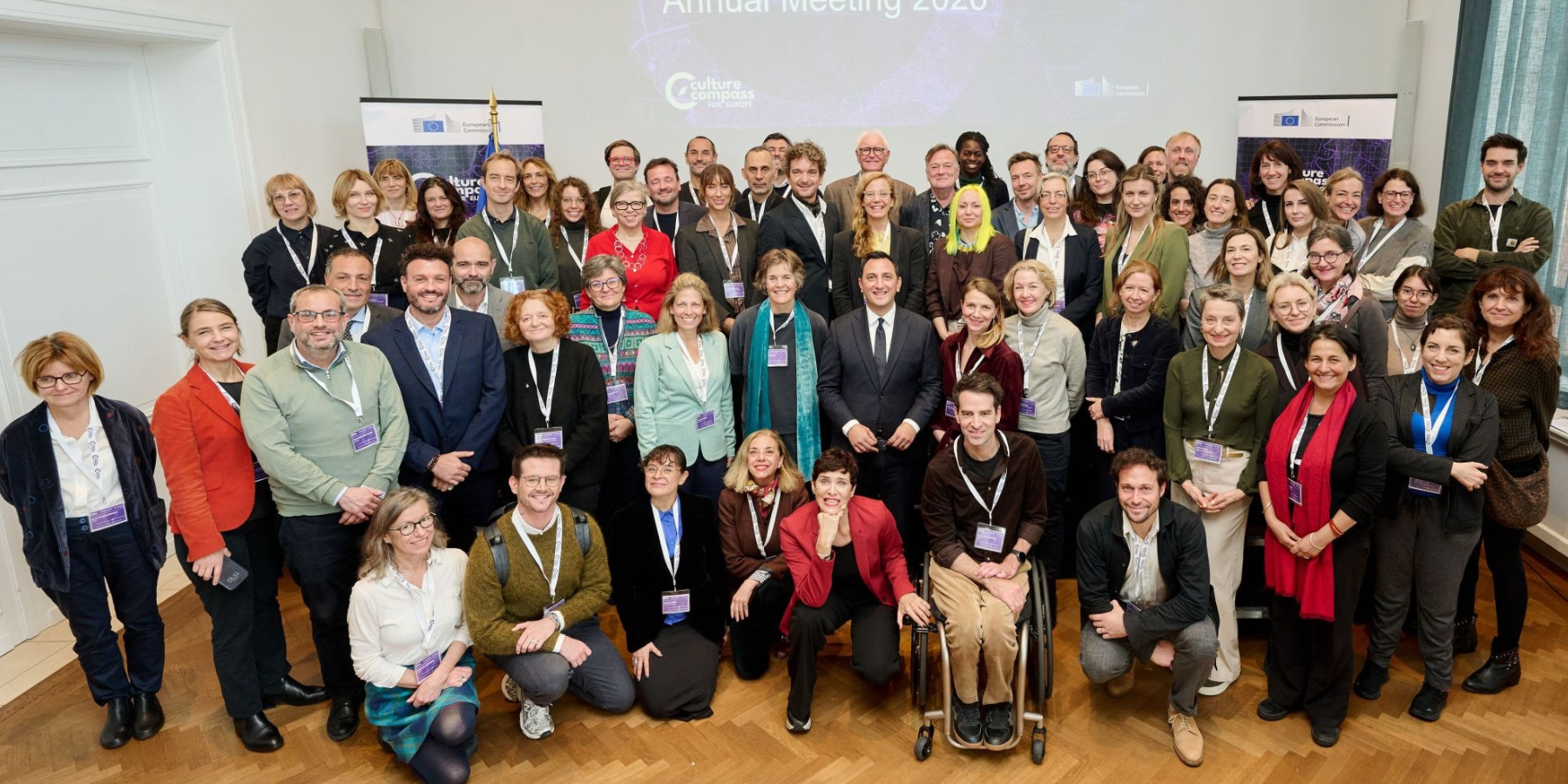
Inside the first EU Culture Dialogue. Will national governments step up?
On 12 November 2026, the first EU Culture Dialogue took place in Brussels hosted by Commissioner Glenn Micallef. The day was full of important announcements from the Commission, lively discussions among 60 representatives of cultural organisations and a bit of planning for the future of EU cultural policy amidst ongoing political drama. Culture Action Europe was represented by Lars Ebert in the morning and Luiza Moroz in the afternoon. Stay with us for this long read as we unpack what happened, what was said and, most importantly, what we made of it all at the end.
I. What is a structured dialogue?
The structured dialogue is a way for the European Commission and the cultural sector to stay in touch and, hopefully, co-create cultural policies together. It gives cultural organisations, networks, and artists a regular opportunity to bring their experience to the Commission, discuss what it is proposing and help decide what should be on the agenda.
The Commission has been organising the structured dialogue in culture in different forms since 2007. From 2015 to 2023, the dialogue took place through Voices of Culture run by Goethe-Institut on behalf of the Commission. Participants developed recommendations on issues such as artists’ working conditions, international cultural relations and the green transition, then discussed them with the Commission. Unfortunately, the link to access those reports is no longer active — a reminder for the new structured dialogue to ensure continuity.
The Commission opened a new round of exchanges with cultural networks in Brussels on 20 March 2025, while it was preparing the Culture Compass. The Compass, published that November, made a commitment to a structured dialogue with civil society for ‘exchange, co-creation, and policy alignment.’ Exactly a year later, on 12 November 2026, Commissioner Glenn Micallef formally launched the first annual meeting of the EU Culture Dialogue in Brussels.
The programme of the event revolved around three big initiatives planned for 2027: the EU Artists’ Charter, the AI Strategy for the Cultural and Creative Sectors, and the Commission’s State of Culture in the EU report focusing on artistic freedom.
Commissioner Micallef acknowledged that one event could only accommodate so many people and topics. ‘This table is here to stay,’ he said. The Commission plans to hold consultations and technical workshops throughout the year, alongside the annual meeting.
At the event, the Commissioner and DG EAC announced other elements of the structured dialogue:
EU Artists’ Survey: launched on 12 November, it asks artists and creative professionals about their working conditions, artistic freedom and how AI affects their work. Micallef singled out fair pay and self-censorship as issues he wants to understand better, and asked the participants to spread the survey across national networks. It takes 5 minutes to complete, is available in all 24 official EU languages and will run every year. The first round closes on 15 January 2027. The results will help inform a future report on the State of Culture in the EU. Our question is how the Commission will ensure a representative sample for the EU Artists’ Survey and whether it could draw on the well-established sampling and weighting methods of Eurobarometer.
The first State of Culture in the EU report, which the Commission plans to publish in the third quarter of 2027. It will bring together economic indicators and evidence from artists, cultural organisations and audiences. The new EU Cultural Data Hub will support the report by collecting and analysing data and tracking trends. Artistic freedom will be a particular focus of the first edition. At the event, the Commission asked participants via Slido what they wanted the report to cover. We hope Slido was just the warm-up for a proper consultation.
The EU Culture Dialogue Community was also presented. Organisations in the cultural and creative sectors can register to receive policy updates, hear about consultations and workshops, and help set the agenda for future annual meetings. The Commission will use the community to seek input on the AI Strategy and the Artists’ Charter, as well as on other files.
Glenn Micallef made another big announcement: the Youth Cultural Ambassadors Network, a flagship action of the Culture Compass, is open to young people. Its members will advise the Commission and contribute to discussions on initiatives such as the European Capitals of Culture and the European Heritage Label.
There are two ways to become a network member. You can apply to the Youth Cultural Ambassadors Network either in your personal capacity, or a cultural organisation can apply and nominate you as its representative. In either case, you must be aged 18 to 29 on the date of application, be a national of an EU Member State, an EFTA/EEA country, an EU candidate country or a potential candidate country, and have experience in culture. The network will have up to 30 members, appointed for a renewable three-year term. How to apply? Detailed rules are here, but basically you/your nominating organisation need to send a cover letter, a Europass CV, and the necessary completed forms to EC-Youth-Cultural-Ambassadors@ec.europa.eu by 4 January 2027.
Once you have clicked through all the links and had a moment of regret that you are over 29 and cannot apply to the Youth Cultural Ambassadors Network, it is time to recap important discussions from 12 November.
II. What did we discuss?
The structured dialogue had three main interactive sessions: on artistic freedom, on the AI Strategy for the Cultural and Creative Sectors, and on the EU Artists’ Charter. All participants had an opportunity to contribute in one way or another. Some network representatives were asked to moderate discussion rounds or act as rapporteurs. Below, we summarise those conversations based on what the rapporteurs reported back in the plenary.
Discussion on artistic freedom
The discussion on artistic freedom covered four topics: 1) monitoring violations; 2) funding conditions; 3) artistic freedom in the digital environment, and 4) the role of cities, regions and public spaces. One point made early in the plenary was that artistic freedom matters to the whole cultural sector and to everyone’s right to access arts and culture. The fight for artistic freedom was framed as a wider fight for democracy and freedom of expression. Here’s what the groups reported back.
1. Monitoring violations. There is a gap between the rights guaranteed on paper and the protection artists can count on in practice. Much of the work of documenting violations falls to a handful of under-resourced civil society organisations. The group called on the EU to fund and coordinate monitoring with civil society, the Council of Europe and UNESCO, and use the findings to hold Member States accountable. Another participant also pointed to a practical problem: complaints mechanisms exist (in the UN, national human rights institutes), but many artists and cultural workers don’t know about them.
2. Funding and censorship. Funding conditions can substantially shape the content of the project and cultural work. The group pointed to the number of boxes applicants have to tick and how easily that can lead artists to change what they propose in anticipation of what will get funded. It suggested a funders’ charter grounded in human rights standards that could guide both public funding and private philanthropy. The group also proposed that the EU should be able to fund independent organisations directly when artistic freedom is under threat, without requiring the national government’s sign-off.
3. Artistic freedom online. We talk about social media as a public square, but the platforms are privately owned. The group asked who owns the data and who can access it. These questions matter for understanding why algorithms amplify some voices and restrict others — languages, minority voices or uncomfortable messages. With governments, we can make freedom of information requests; but that’s not possible with big tech platforms. Limited access to data means it is difficult to exercise the right to be forgotten online.
Participants also talked about how quickly harassment can intensify online. They called for better enforcement of existing rules and for artists to participating in designing technology they use.
4. Cities, regions and public spaces. What can a city do when an artist needs somewhere safe to work, or want to perform a controversial work? Local authorities can provide safe public spaces for democratic debate and independent arts scenes, give places to live, create and perform, and help artists at risk find safe residencies. The group pointed to libraries and cultural venues as places where difficult conversations can happen in public. Apart from funding those spaces, resources are needed to programme cultural work and make it accessible. Local cultural exchanges were another idea the group raised.
The topic of self-censorship emerged again in the reactions of the audience. Participants described how pressure from politicians, funders or the public can make museums, cinemas, booksellers and libraries think twice about showing controversial work. After numerous panels and workshops, they want to see concrete protections put into practice. Some also called for ‘legal imagination’ and ‘legal courage’ in Europe.
Commissioner Micallef said he was wary of giving any politician, himself included, the power to decide what art is acceptable. ‘Art is all about provocation,’ he said. He also saw scope for the Commission to work with civil society and partners (such as the Council of Europe) to monitor violations.
Discussion on the AI Strategy for the Cultural and Creative Sectors
Presenting their work on the AI Strategy for the Cultural and Creative Sectors, DG EAC announced that copyright is not within the scope of the Strategy because it requires separate legislative tools. The representative from DG CNECT in his introduction focused mainly on transparency rules of the AI Act, such as the labelling of AI-generated content and deepfakes.
The discussion among the participants of the structured dialogue was organised around four topics: 1) ethical innovation; 2) AI-generated content; 3) cultural diversity in AI, and 4) AI literacy, training and capacity-building. Here are the takeaways the moderators reported back in the plenary:
1. Ethical innovation. The group’s key message was that people and ethics must come first. We should use the time we save through AI to invest in human relationships and improve the quality of our work. This is very much in line with the human-centred approach in the recommendations of our AI and Digital Action Group. One of the participants made a practical suggestion to start ethical innovation with governments: public authorities should use their purchasing power and buy and use only ethical AI tools from providers that license their training material.
2. AI-generated content. The group called for clear EU rules requiring both machine-readable marking and labels that audiences can understand when AI-generated material is presented as fiction or another cultural product. It also proposed a study to assess the jobs and income already lost due to AI and the damage to creators’ reputations. Another idea was to ban public funding for AI-generated projects, give priority to human-made work, and fight the platform algorithms that make European cultural content harder to find.
3. Cultural and linguistic diversity. The participants proposed a shift from protecting diversity to actively enhancing it. They want to have more diverse training datasets, with better representation of minority languages and under-represented cultures. We need to work with the communities concerned to build and curate those datasets, seek their consent, respecting copyright and track data provenance. The group also called for stronger rules, indicators and checks to assess how AI systems represent cultural and linguistic diversity, identify potential gaps or biases both in datasets and outputs, and track whether regulatory commitments are actually being implemented. It’s important that cultural and creative professionals are represented in AI governance and advisory bodies and have a say in developing AI policies.
4. Training and capacity-building. Who needs them? Artists and cultural organisations as well as cities, regions and other public authorities. Artists need to understand how AI systems work so they can make informed choices about using them and influence how they are developed. Being aware about one’s intellectual property rights and how to exercise them should be part of capacity-building.
Copyright came up anyway. It is hard to discuss ethical innovation or more diverse datasets while the technology itself is built on stolen content. Indeed, the Commission is exploring a possible legislative initiative on copyright separately from the AI Strategy (the consultation closed on 10 November). But it remains unclear whether the new initiative will truly address the demands of creators. For example, the response options in the consultation mainly focus on how to make opt-outs work better: common standards, an EU register, measures on licensing… Opt-ins, however, are off the table, contrary to creators’ calls for prior authorisation.
That is why the idea of using AI as a tool to ‘enhance creativity’ or ‘help artists’ gets mixed feelings. Some of the artists invited to the structured dialogue find ways to co-create with a machine; others turn down post-editing AI translations because for them, the work begins with hearing the author’s voice: ‘The machine can’t hear the voice that I can hear.’
Many in the room believed that the main role of the EU in AI policies is setting the guardrails because big tech companies have little incentive to set those limits themselves. Present in the room Frank Wynne, an Irish translator and writer, adapted Isaac Asimov’s Three Laws of Robotics for the occasion: 1. AI should not injure human culture or, by inaction, cause it to be harmed. 2. AI should obey human instructions inasmuch as this does not conflict with law one. 3. AI should sustain itself only inasmuch as this does not conflict with laws one and two.
Discussion on the EU Artists’ Charter
The discussion on the EU Artists’ Charter took the form of a World Café with four topics: 1) freedom of association; 2) social security; 3) fair treatment and remuneration; and 4) recognition as an artist. Your humble writer moderated the table on recognition as an artist and thoroughly enjoyed the conversations. We had very little time in each round, but people got straight to the tricky questions.
1. Freedom of association. The group saw both a need and an appetite for collective mechanisms and standards for fair practice, working conditions and rates of pay for the whole workforce. That appetite came from solo self-employed workers and, perhaps more surprisingly, from employers and funders too. The 2022 guidelines opened up opportunities to do this. What’s missing is investment. Setting working conditions collectively requires support for grassroots initiatives, small associations and fledgling unions that could grow into this role. Education is also important. Workers entering the sector need to know where to find information on working conditions and how to get organised.
2. Social security. The group agreed that all artists should have access to social protection, whatever their occupation, employment status or source of income (salary, fee, royalties, etc.). Participants called for particular attention to healthcare, support during maternity leave, unemployment benefits and access to pensions.
One proposal was an EU-wide social protection scheme for artists. The group pointed to the European Health Insurance Card and the European Social Security Pass as examples of how EU tools can help people access healthcare or prove their social security rights across borders.
The group also saw room for targeted initiatives to address specific needs, such as access to unemployment support between jobs.
3. Fair treatment and remuneration. The group saw social conditionality as a practical way to ensure fair pay and working conditions. Funders could make support conditional on applying collective agreements and using written contracts. Collective agreements should cover solo self-employed workers too. Views differed on issues such as buyout clauses, as practices vary across stakeholders. The group stressed the role of social dialogue in developing professional standards that fit how people actually work in each sector.
4. Recognition as an artist. Before the Charter defines an artist, we must understand what we need the definition for. If the Charter sets out common principles, its scope should be as broad as possible. The Charter should cover not only artists, but also other workers in the cultural and creative sectors, with different employed statuses. Within that broad scope, separate definitions of artists and other workers are still needed to reflect the peculiarities of the sectors (this is also the approach adopted in CAE’s Sector Blueprint for the Charter). However, if the Charter creates specific benefits or entitlements, we may need to be more selective about who qualifies so that each benefit reaches the people it was designed to support. Those criteria would need to respect existing national definitions and legal frameworks.
III. What do we think about the structured dialogue?
Overall, it was a good day full of meaningful conversations. The format of the group discussions is particularly appreciated: even with a packed agenda, we managed to talk things through. For the future, we’d happily trade a few boards and post-its for more group exchanges.
We were also encouraged to see further initiatives, such as the Cultural Dialogue Community, to keep the conversation going. We count on their proper implementation and meaningful follow-up.
In his opening remarks, Commissioner Micallef acknowledged continuous cooperation with civil society: ‘You asked for fairer working conditions, and we put them into the AgoraEU proposal… You asked us to stand up for artistic freedom, and we’ve included measures of support…’. We value the genuine partnership with the Commission and the attention and openness with which colleagues at DG EAC listen to what we bring to it.
One thing Culture Action Europe would welcome in the future is clearer and more transparent criteria for invitations to annual meetings. We understand that it is impossible to include everyone and appreciate the efforts to provide alternative opportunities for participation and consultation. Nevertheless, it would be useful to understand the principles guiding participation: which sectors are represented, what role EU-funded networks play, and how organisations and individuals are selected.
Commissioner Micallef spoke about fear in the face of contemporary challenges and the need to overcome it. Deep cuts to AgoraEU on the table have created a sense of urgency in the room. With so much at stake, one key actor was missing from the structured dialogue: Member States.
We understand that this particular dialogue may not be designed for their participation, as it is the Commission’s process. However, there are no comparable spaces for structured exchange between civil society and the Council. Could the structured dialogue with the Commission also involve Member States, similarly to the expert group on cultural heritage, which includes representatives of national ministries? It’s never easy given the limited flexibility of Member States officials to engage in dialogue beyond positions coordinated at the national level. It is also important to preserve the spirit of open and genuinely horizontal dialogue with civil society that we experienced during the structured dialogue. But without doubt, at this stage, much of the advocacy needs to shift towards the Member States.
First, AgoraEU. Reversing the proposed budget cuts will require pressure on national capitals. The new negotiating box to be presented by António Costa on 21 November is unlikely to reverse the cuts — it’s the heads of government that decide.
Second, the inclusion of culture in the National and Regional Partnership Plans (NRPPs) also depends entirely on Member States. National governments are developing these plans, and we need to work directly with them to ensure culture is included.
Third, the EU Artists’ Charter. Putting it into practice will take close cooperation with Member States, particularly on working conditions and social protection.
It’s worth reading the Council’s new Work Plan for Culture alongside what we heard at the structured dialogue. For example, the Work Plan provides for Member States’ input into the EU Artists’ Charter, which we welcome. But if the first draft included a dedicated action on structured consultation around the Artists’ Charter, the final version removes this action from the annex timetable. Alas, the commitment is softened.
Culture Action Europe had also advocated for a structured dialogue between civil society and the Council, but this proposal was not included in the new Work Plan. We’d still love to see Member State representatives join some of the future editions of the dialogue, and for the Council to hold regular exchanges of its own with cultural civil society.
The event on 12 November made it clear that the next phase of advocacy needs to be much more strongly targeted at Member States and that we in the cultural sector need to step up our engagement at national level. While maintaining the constructive dialogue with the Commission, we encourage our members to focus their advocacy on national governments to ensure stronger AgoraEU, NRPPs and the EU Artists’ Charter.
‘Keep speaking to governments, keep speaking to ministers, keep speaking to all Members of the European Parliament, and demand that the European Parliament makes [AgoraEU] a condition in negotiations on the EU budget,’ concluded the Commissioner.
Image source: European Commission, 2026