A 30% cut to AgoraEU? Dubious savings with major consequences
Culture Action Europe strongly opposes the cuts to AgoraEU set out in the Irish Presidency’s negotiating box for the EU’s 2028-2034 Multiannual Financial Framework (MFF), published on 10 October 2026.
Under the proposal, funding for AgoraEU, the future EU programme for culture, media and democracy, would fall from the Commission’s €8.6 billion to €6 billion in current prices — a 30% cut.
AgoraEU is among the hardest-hit programmes. The Irish Presidency also proposes -10% for Horizon Europe, -13% for the European Competitiveness Fund and -16% for the Global Europe Instrument, compared with the Commission’s allocation.
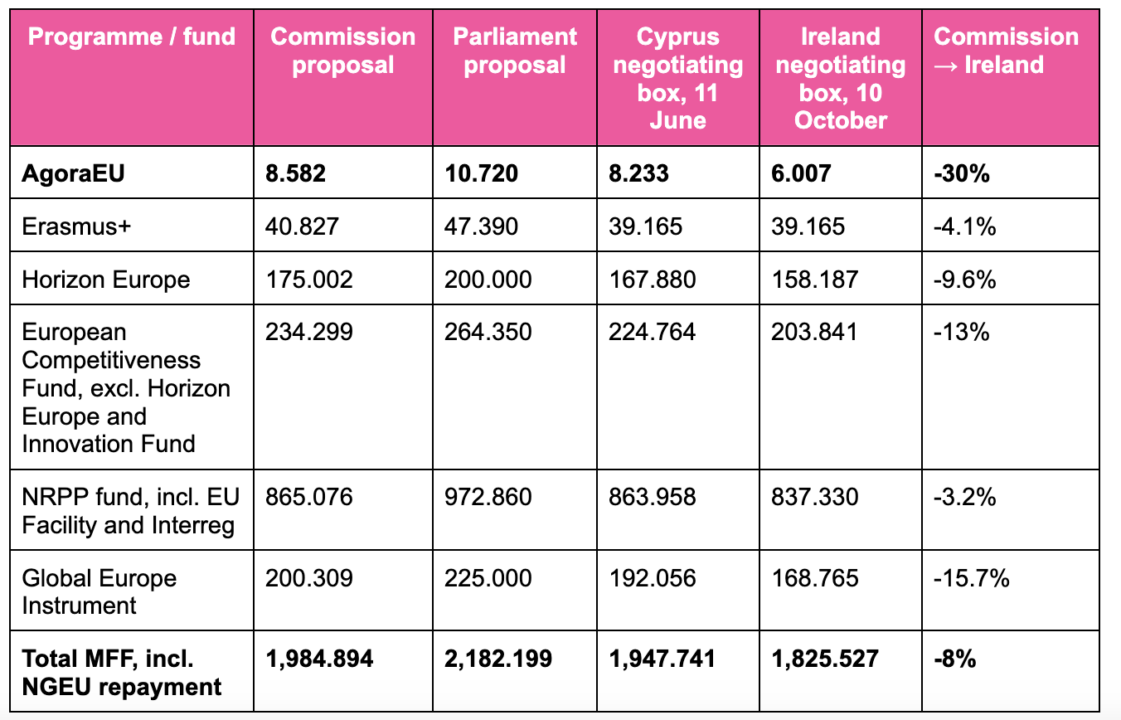
All amounts are in € billion, in current prices, for 2028-2034.
The disproportionate cuts are completely at odds with the commitments to support culture in the Joint Declaration ‘Europe for Culture – Culture for Europe’ that the Council co-signed in June 2026.
It is especially disappointing to see this proposal coming under the Irish Presidency, a country known for its sustainable support for culture and its bold and successful Basic Income for the Arts scheme.
Member States still have the opportunity — and responsibility — to change their position. Ahead of the European Council meeting on 15-16 October, where EU leaders will discuss the next MFF, Culture Action Europe calls on governments to reverse the disproportionate cuts to AgoraEU and restore at least the Commission’s proposed allocation.
Read our arguments for reversing the cuts — and share them with your national governments
First, a 30% cut to AgoraEU saves only about 0.13% of the proposed MFF. Yet it would remove almost a third of the resources intended to support European cultural cooperation, audiovisual production, independent journalism and civil society. Why does a programme contributing so little to total expenditure deserve a reduction almost four times the overall percentage cut?
Second, Europe needs a strong cultural and democratic life to withstand authoritarian influence. Russia’s 2026 federal allocation for culture and media amounts to approximately €4.8 billion — more than five times AgoraEU’s annual average proposed under the Irish negotiating box. If the governments are indeed as alarmed about propaganda and authoritarian influence as they sound, they should not weaken European support for independent culture, media and civil society. As Václav Havel argued, resistance begins with supporting the ‘independent life of society’, exactly what AgoraEU is designed to sustain.
Third, Europe should enter the AI transition with confidence in its cultural strength. Given how AI companies use cultural content without asking creators or paying them, AgoraEU must sufficiently support artists in creating new work, protecting their rights, collaborating across borders and choosing their own direction. A Europe that wants to lead in AI should be equally ambitious about its culture.
Fourth, who controls distribution matters for Europe’s cultural sovereignty. Approximately €87 of every €100 earned from video streaming subscriptions in Europe go to US companies. Their decisions shape which stories reach audiences and on what terms. Supporting European production, distribution and cooperation helps European producers reach wider markets and negotiate from a stronger position. If governments want greater European autonomy, they should invest in Europe’s ability to bring its own stories to audiences.
Fifth, European funding helps national spending on culture go further. It multiplies national funding. Take publishing: a government can help get a book into print, but reaching readers in another language is tricky. European support can cover translation and distribution and connect publishers and translators across countries. In 2021-2023, Creative Europe helped pay for the translation of almost 1500 books. Thus, a ministry that already funds its own authors gets more for its money: the EU helps those books find readers in other countries.
Apart from the strong AgoraEU programme, culture must also have a secure place in the programmes funding research, innovation, regional development, and external action. It cannot be left dependent on occasional calls or discretionary national priorities. Dedicated funding in Horizon Europe, the European Competitiveness Fund, Global Europe, and National and Regional Partnership Plans must complement AgoraEU.
We stand in solidarity with our colleagues in the audiovisual sector, independent media, civil society, who would also be affected by the cuts proposed by the Irish Presidency. All strands of AgoraEU need sufficient resources. Negotiations must strengthen the programme as a whole.
As part of the Future of Europe coalition, Culture Action Europe has joined the broader civil society call to protect AgoraEU funding from cuts and invites other organisations to do so too.
Culture Action Europe is calling on Member States not to agree to the proposed cuts to AgoraEU, but instead to provide the resources Europe’s culture, media and democracy need.
We are also calling on the European Parliament not to consent to an MFF proposal introducing such disproportionate cuts. We count on the leadership of the CULT, LIBE and BUDG Committees.