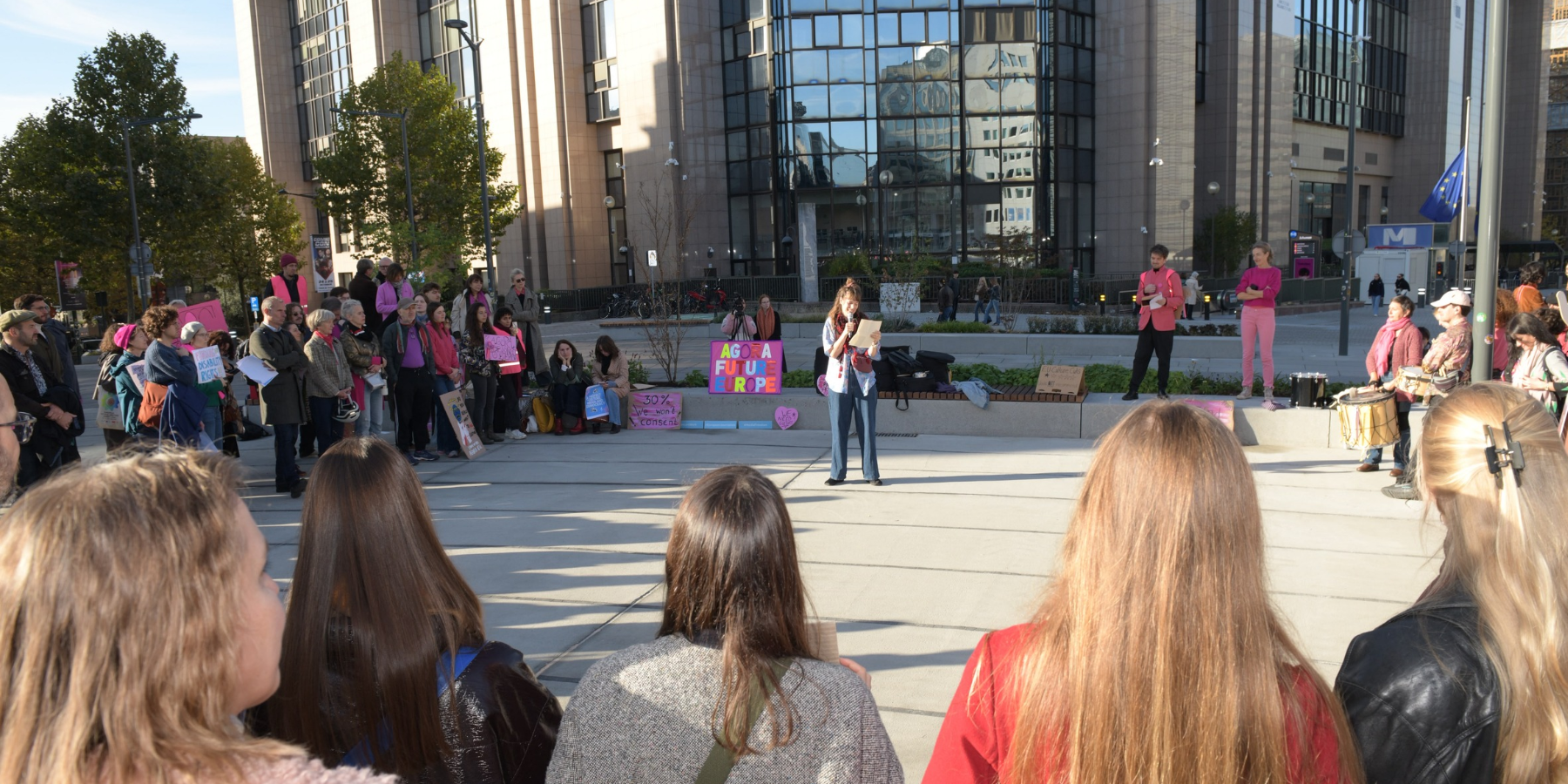
Culture, media and civil society rally at Schuman against proposed 30% cut to AgoraEU
This text is adopted from the press release shared by the organisers of the #StandUpForAgoraEU protest in Brussels on 29 October 2026 opposing the 30% cuts proposed by the Irish Presidency of the Council to the AgoraEU programme. Further reflections and reactions to the protest will be shared soon.
More than 150 artists, cultural workers, journalists, independent media and civil society representatives gathered at Schuman Square this morning in Brussels to demand a stronger future for European democracy.
As the European Union institutions negotiate the EU’s next long-term budget for the 2028-2034 period, Member States, under the Irish Presidency, had proposed significant cuts. While several programmes faced reductions, AgoraEU was hit hardest: from €8.6 billion to €6 billion.
Activists call for the reversal of the proposed 30% cut and to increase EU funding for culture, media and civil society to at least €10 billion. They argue that the cut is disproportionate and ‘saves’ only about 0.2% of the proposed EU budget. Yet it would remove almost a third of the resources intended to support European cultural cooperation, audiovisual production, independent journalism, civil society, equality, rights and values.
Many wore pink, carried hand-painted signs and chanted phrases such as: ‘Stand Up for AgoraEU’, ‘30% — we won’t consent’, ‘Democracy needs imagination’, and ‘Fund Our Future’. The peaceful demonstration was organised by Culture Action Europe, Civil Society Europe, European Civic Forum and the European Federation of Journalists in partnership with the Future of Europe cohort.
A call for action
The protest comes at a decisive moment. Politicians want to agree on the size of the EU budget by the end of this year. Later in November, EU leaders will meet again in Brussels to discuss the budget. Protesters hope that the figures can still change.
‘The proposal to cut AgoraEU is a disaster. It makes us wonder how much strategic thinking went into the new budget planning. In difficult times, we need to invest in what matters. We need to strengthen what has made Europe known around the world: its creativity, innovation, inventiveness, and the free exchange of ideas across borders. During the war, Ukraine proposed to increase its culture budget by 27% next year. So why is Europe going in the opposite direction? It’s a shameful decision.’
– Lars Ebert, Secretary General of Culture Action Europe
While Member States want to cut the budget, other EU institutions support greater investment. The European Parliament is calling for €10.7 billion for AgoraEU. Nela Riehl, Chair of the European Parliament’s Committee on Culture and Education, said at the protest:
‘They want to defund our democracy. They pick culture, media and civil society because they think they’re easy targets and no one will notice, but this is where democracy lives; if the cuts go through, people will wake up one day and ask: why are my rights not protected? Why has that film festival disappeared? Where has my local publisher gone? It causes enormous damage.’
The protesters were also joined by members of Belgium’s cultural sector, who face similar cuts at home. The Flemish government has announced €47 million in annual culture cuts from 2027. For the organisers, the Flemish and European cuts reflect the same problem: policymakers continue to treat culture as an easy place to save money, overlooking its role in democracy and public life.
The stakes go beyond culture. Independent journalism is also under attack. 1481 press freedom violations were reported across EU Member States and candidate countries in 2025. These include physical assaults, threats and legal action against independent reporting. Local newsrooms are fighting to survive. For the organisers, cutting AgoraEU now means undermining people’s access to reliable information at the time it needs strengthening.
‘When local newsrooms close, nobody covers the town council, the hospital board or the local election. That gap gets filled by rumour, spin and disinformation. Journalism is how citizens hold power to account. Europe can’t defend its democracy and underfund it at the same time. Our politicians, many of them talking about the crucial role of independent journalism and press freedom at international events, do not seem to take their own words seriously. Journalism is important for security, business, trust and social inclusion. It is a civilisational issue. But to be trustworthy and honest it needs to be nurtured and protected.‘
– Renate Schroeder, Director of the European Federation of Journalists
Civil society experiences the same pressure. 67% of human rights organisations face online attacks or threats, and 39% suffer politically motivated funding cuts according to a FRA report. Civil society organisations monitor the rule of law, promote fundamental rights and values, defend and support people facing discrimination, as well as victims of violence often where national funding is scarce. The EU Strategy for Civil Society commits to sustainable funding. A 30% cut to AgoraEU would leave that promise unfunded and leave many civil society organisations at national and EU level working on fundamental rights, democracy, non-discrimination, gender and LGBTI equality without funding in a moment where attacks on civic space, on women’s and on minority rights are on the rise.
‘EU funding has been essential for the sustainability of EU civil society networks and a crucial lifeline for civil society organisations in countries like Hungary and Poland where funding for civil society was reduced under political pressure: the proposed reduction of the AgoraEU budget will seriously affect the possibility for associations, to support their communities, make citizens’ voices be heard at all levels of government and act as watchdogs for rights violations.’
– Gabriella Civico, President of Civil Society Europe.
Commenting on the proposed cuts, Natacha Kazatchkine, Secretary General of the European Civic Forum, said:
‘The Irish presidency is proposing to make savings to the overall budget of just 0.2%, while hitting civil society with a 30% cut. These are tiny savings with a huge cost for democracy. Ireland should rise to the moment and push for a budget that supports civil society and invests in our democracy.’
Following the demonstration, a small delegation gathered with the aim of delivering the joint letter against the cuts, backed by more than 1,000 organisations, to representatives of the European Council and the Irish Presidency of the Council of the EU. At the end of the day, the protesters remained hopeful. For them, AgoraEU embodies Europe’s creativity, inventiveness and exchange of ideas that have shaped the continent for centuries. They hope that their peaceful demonstration will remind EU leaders to invest in what matters.
Further reading
- 900+ and rising: Europe calls on the EU Council to defend AgoraEU ·
- A 30% cut to AgoraEU? ·
- The Council’s MFF budget proposal ·
- 150+ organisations call for a more ambitious budget
- Culture in National and Regional Partnership Plans
Image: Luis Hidalgo Photography, StandUpForAgoraEU Protest