
Culture in National & Regional Partnership Plans (NRPPs)
This article is an extract of a special edition of the Brussels Decoder, Culture Action Europe’s monthly members-only publication containing regular updates and analysis on EU(ropean) cultural policy and politics. If you wish to receive regular updates on the MFF and other EU(ropean) cultural policy developments in the future, consider becoming a Culture Action Europe member: discover all the advantages linked to the membership here. If you are interested in learning more about NRPPs and taking action for a stronger cultural presence, register for the Campaign Meeting on NRPPs on 23 September 2026 here.
Over the past year, Culture Action Europe has spent a lot of time decoding EU funding programmes that can support culture in the next seven years: AgoraEU, Horizon Europe and the European Competitiveness Fund.
But there is another, very large piece of the next EU budget that deserves considerably more attention from the cultural sector: National and Regional Partnership Plans (NRPPs).
How large? €865 billion for 2028-2034 — almost half of the entire EU budget.
Unlike AgoraEU or Horizon Europe, where EU institutions in Brussels decide what gets support, NRPPs will be written by Member States. The plans bring EU funding closer to national and regional needs, but also give governments more influence over how common EU priorities are translated into spending. Each country will prepare one big plan proposing the reforms and investments it wants to finance with EU money.
If we want those plans to support culture, our advocacy should move to national capitals. Calling for cultural chapters in NRPPs is the next step in Culture Action Europe’s Ask, Pay, Trust the Artist campaign, backed by more than 2000 voices from across the cultural sector.
Inside an NRPP
Each Member State will put together a package of reforms and investments that respond to its national and regional challenges. In practice, that could mean renovating schools, building affordable housing, upgrading a local electricity grid, improving a rail connection or water system, or providing income support to farmers. Plans can have national, sectoral and regional chapters. We want Member States to use this structure to create dedicated cultural chapters.
The plans would cover 2028-2034, but the money would not simply be handed over for seven years. Member States would submit their plans to the Commission by 31 January 2028, the Commission would assess them, and the Council (=EU body representing national governments) would formally approve them, hopefully by July 2028. Funding would be released as countries deliver the agreed reforms, investments, milestones and targets, with monitoring and audits along the way. The details of the process are still being negotiated: at EU level, the Council adopted its partial position in June, while Parliament is still working on its mandate. But the basic structure is already on the table.
The size of the national envelopes is still part of the Commission’s proposal and has not yet been finalised. Poland currently comes out on top with around €123.3 billion, followed by France (€90 billion), Spain (€88 billion) and Italy (€87 billion), while Luxembourg, Malta and Cyprus receive the smallest amounts. The logic is broadly redistributive. Larger and less prosperous countries tend to receive more, although the formula also takes into account regional disparities, rural and agricultural needs, migration and border pressure.
When it comes to individual NRPPs, governments are already deciding priorities, negotiating between ministries and regions and setting up consultation processes. In theory, the plans should not be written just by finance ministries behind closed doors. Member States are supposed to involve regional and local authorities, social partners and civil society. And in some countries the machinery is already moving.
Estonia began stakeholder consultations back in October 2025 and plans to agree on the broad allocation of its NRPP funding this autumn.
Poland is another frontrunner. It launched preparation of its plan in January 2026. Poland is the largest beneficiary of the NRPP money, so unsurprisingly Warsaw is doing its homework well in advance.
By March, the Polish Ministry of Development Funds and Regional Policy had assembled a team of more than 80 representatives from ministries, regions, local government, social and economic partners, academia and NGOs. Poland plans 16 regional chapters and expects regional authorities to manage 44% of the funds. Working groups are now digging into more specific policy areas.
One detail worth noticing: when Poland invited civil society organisations to the preparation team, the thematic slots included education, democracy, migration, and social inclusion, but not culture as a standalone category.
Finland is moving too. In June, the government put the Ministry of Finance in charge of preparing the plan, together with the Prime Minister’s Office, and created a group bringing together all ministries. In autumn, the group will expand to regional and local authorities, social partners and civil society organisations.
The timetable and process vary from country to country; governments are moving at very different speeds. But the direction is clear: 2026 is the programming year, and the autumn will be decisive, so the cultural sector needs to get engaged ASAP.
We have seen this film before
Although NRPPs are a new feature of the EU budget, they bring together funding models the EU has used before.
A large part comes from today’s cohesion funds, including the European Regional Development Fund and European Social Fund+. They are meant to reduce regional disparities and support jobs, infrastructure, social inclusion and local development. They are run through shared management, meaning national and regional authorities decide how EU money is programmed and spent, under EU rules and usually with national co-financing. In 2021-2027, around €5.3 billion in EU cohesion funding was planned for cultural heritage and cultural services, rising to about €7 billion with national co-financing.
NRPPs also build on the precedent of the Recovery and Resilience Facility (RRF), the major EU fund established during the pandemic. It operated on a similar principle: Member States received EU funding in exchange for reforms to support their economies in times of crisis.
Back in 2020, when the Recovery and Resilience Facility emerged, Culture Action Europe, together with more than 110 cultural organisations, campaigned for governments to allocate at least 2% of their national recovery plans to culture. Moreover, the letter called on national governments to ‘engage the representatives of their cultural communities and civil society organisations in the design and implementation of the National Recovery and Resilience Plans.’
The 2% earmark was never reflected in legislation governing the Recovery and Resilience Facility, but eventually, the target was achieved. The European Commission reported that €11.7 billion directly supported culture and cultural and creative sectors across 18 Member States.
However, the picture between countries was uneven. A small number of countries, such as Italy and France, pulled up the European average, while many Member States were around 1% or had no specific cultural allocation at all.
The Recovery and Resilience Facility precedent is both encouraging and instructive. Culture does not need an EU earmark to find its way into national plans, but it does need national actors pushing for it. The earlier they enter the process, the better the chances that culture becomes part of the plan.
Dreaming of 2%
Culture Action Europe made a projection. The new NRPP Fund totals around €865 billion, but part of it is earmarked for migration and security and for the Social Climate Fund. For this exercise, we therefore worked with the remaining General Allocation—around €750 billion—and calculated what would happen if 2% of each national plan went to culture. Because the plans cover seven years, we divided that amount by seven to show the approximate annual equivalent. Allocating 2% of NRPPs to culture would amount to approximately €15 billion over seven years.
But that’s not all. Most NRPP measures will also require national co-financing. Depending on the region, governments would cover at least 15%, 40% or 60% of the total cost. So €15 billion in EU funding would translate into a larger overall investment in culture. We cannot calculate the national contribution yet because the rate depends on a region. What is clear is that national advocacy matters even more: getting culture into an NRPP also means getting governments to put their own money behind it.
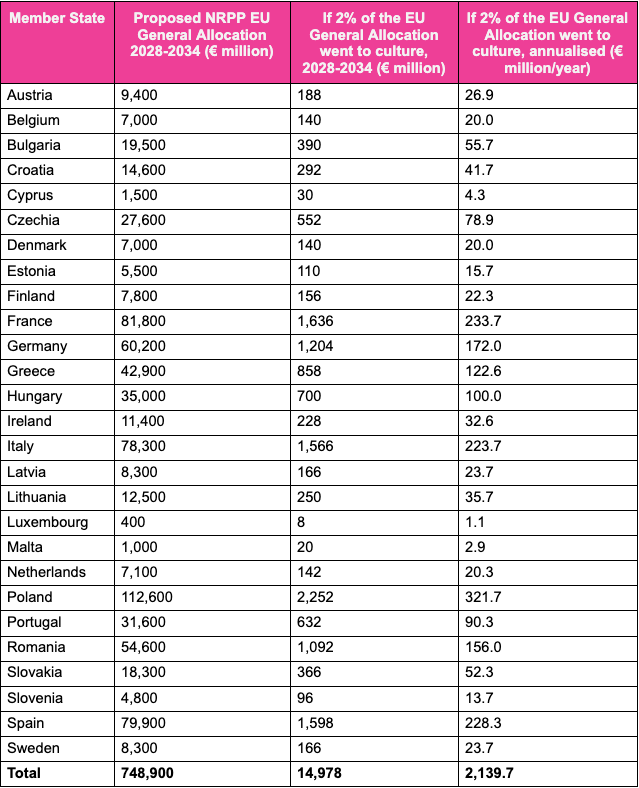
Data source: European Commission, ‘MFF 2028-2034: National and Regional Partnership Plans Allocations,’ 2026.
What can NRPPs do for culture?
The exact legal wording of the next EU budget is still being negotiated, but the direction is broad: ‘promoting culture as a catalyst for European values and supporting a vibrant and diverse cultural sector’. This gives Member States plenty of room to shape their own priorities. For inspiration, let’s look at what countries did with the Recovery and Resilience Facility during the pandemic.
Different countries chose different tools to support culture.
Italy allocated €4.2 billion on culture, including more than €1 billion for its Borghi programme to revive historic villages through heritage, cultural activities, tourism and local development. Around half of this money went to just 21 pilot villages, roughly €20 million each. The concentration of such large sums in individual villages prompted debate. One of the examples was Elva in Piedmont, a municipality of just 78 inhabitants, which received a €20 million allocation and later faced questions over changing projects and transparency. ‘The projects were designed from the top down, with objectives and intervention priorities shaped more by ministerial requirements than by local communities,’ a later investigation into Elva reported.
Spain used its plan to build the Spain Audiovisual Hub. The original recovery plan allocated €200 million to the audiovisual sector, but after Spain revised the plan in 2023, the component grew to around €1.93 billion. Money was spent on audiovisual production, video games and digital creation, internationalisation and regulatory reform. Spain invested in creative industries as an economic growth sector. Spain is also a good example of how national plans are not necessarily set in stone and can be revised and substantially expanded along the way.
Croatia invested into a new copyright reform to bring Croatian rules in line with the EU Digital Single Market framework. It then backed this up with more than €33 million in grants to help cultural and creative organisations and SMEs adapt their business models, software, distribution and digital production. In addition, Croatia allocated around €40 million to the energy renovation of cultural heritage buildings. The call covered energy-efficiency measures, renewable energy, seismic resilience, fire safety, accessibility and other improvements.
There are plenty of lessons from the pandemic funding, and one of them is that how the money is spent matters as much as how much is allocated. Geographical balance, support for small and independent actors, fair pay and respect for artistic freedom should be taken into account when designing the plans.
Brussels cannot dictate how national capitals will support culture. The new National and Regional Partnership Plans framework is deliberately giving Member States room to respond to their own national and regional challenges. What culture needs in Poland, Finland, Croatia or France depends on the country, the region and the cultural ecosystem itself. Restoration? Digitalisation of heritage? Better working conditions for artists? Support for creative businesses? There is no one-size-fits-all answer.
This is precisely the value of NRPPs. It is not only about the size of the pot—although 2% of it means more money for culture than in AgoraEU, Horizon Europe and the European Competitiveness Fund altogether—but about where that money goes. Unlike Brussels-managed programmes, NRPPs are built around national and regional needs, which makes them much closer to the cultural sector on the ground and relevant to the local organisations that may never apply directly for an EU programme like AgoraEU. But while Member States have plenty of room to set their own priorities, the plans are meant to serve common EU goals and respect EU rule of law and fundamental rights standards.
No Brussels copy-paste
Culture will not appear in national plans by default. Somebody has to put it there. And that somebody is your government that needs to hear from you.
Culture Action Europe has prepared an open letter to the European institutions and Heads of Member States calling for culture to be included in NRPPs and for the cultural sector to be consulted in their preparation. But the substance—what should be supported and why it matters to local communities—should come from citizens themselves.
That’s why we encourage our members across the EU, Culture Action Europe’s regional hubs and other interested organisations to start national advocacy now and make the case to their governments for cultural chapters in their NRPPs. This could mean real money reaching the sector on the ground. No one is better placed to argue for the right priorities than those who know the local context and needs.
Below is a checklist on how to get heard.
- Find out who is writing your country’s plan.
Which ministry is coordinating it: finance, regional development, economy, European affairs? Who is responsible for the relevant chapters? What role do regions have? Has a working group already been created? When and how will civil society be consulted? - Build the cultural coalition.
Bring together different cultural organisations in your country, including regional organisations and independent actors. If you’re a Culture Action Europe member, leverage our regional hubs. The goal is to agree on two or three structural problems where EU investment could make a difference in your country and to push for such measures in the NRPP together. - Turn needs into reforms and investments.
What needs to change and what would make that change possible? There is no perfect demand that can simply be copied into 27 national plans. Better to arrive with a few concrete priorities, be it a reform of artists’ working conditions, investment in cultural infrastructure, support for digital transition, or whatever your national context actually calls for. If relevant, consider existing cultural strategies or bodies that could serve as useful channels for distributing funding. - Talk to your government.
The culture ministry is an obvious ally, but it will rarely be leading the NRPP. Depending on the country, the key ministries may be finance, cohesion and regional development, economy, European affairs or the prime minister’s office. Write to them and arrange meetings with them to present your proposals on culture. - Start now.
From June 2027, countries will start sending draft plans to Brussels. Which means the writing is happening right now, right in autumn 2026. Check your national timetable, watch for consultations and working groups, and try to get into the process while priorities are still being shaped.
Learn more about the NRPPs and how you can support a stronger presence for culture in national plans by joining our campaign meeting on culture in NRPPs on 23 September 2026 at 10:00 Brussels time.
Image: West Satellite BEYOND in Amsterdam; Photographer: Jelmer de Haas Photography, 2026.