Parliament has an AgoraEU deal. What did culture get?
On 19 November, the European Parliament’s Culture and Education (CULT) and Civil Liberties, Justice and Home Affairs (LIBE) committees achieved a compromise on AgoraEU, the EU’s programme for culture, media and civil society for 2028-2034. The vote sets the basis for Parliament’s position in further negotiations with the Commission and Council — the committees voted to enter interinstitutional negotiations on the basis of the compromise text.
For culture, there is much to welcome. MEPs want to secure the Culture strand’s share of the budget, strengthen provisions on working conditions and simplify funding procedures. Artists facing forced displacement would have dedicated support. The biggest concern is international cooperation: the compromise would make it even harder to work with organisations from countries that do not participate in the programme.
Five strands, 21% for culture
Under Parliament’s compromise, AgoraEU would have five earmarked strands. Each strand would have its own share in the programme’s budget (Article 11) and its own budget line. Culture Action Europe has been calling for earmarking because cultural organisations need predictability and certainty.
- Creative Europe – Culture: 21%
- Media: 25%
- News and Journalism: 13.5%
- CERV+: 29.5%
- Daphne: 11%
Up to 5% of each strand’s allocation could be used for horizontal and cross-cutting priorities.
At 21%, the Creative Europe – Culture strand keeps the same share as in the Commission proposal. Culture Action Europe and more than 150 cultural organisations have called for at least 25%.
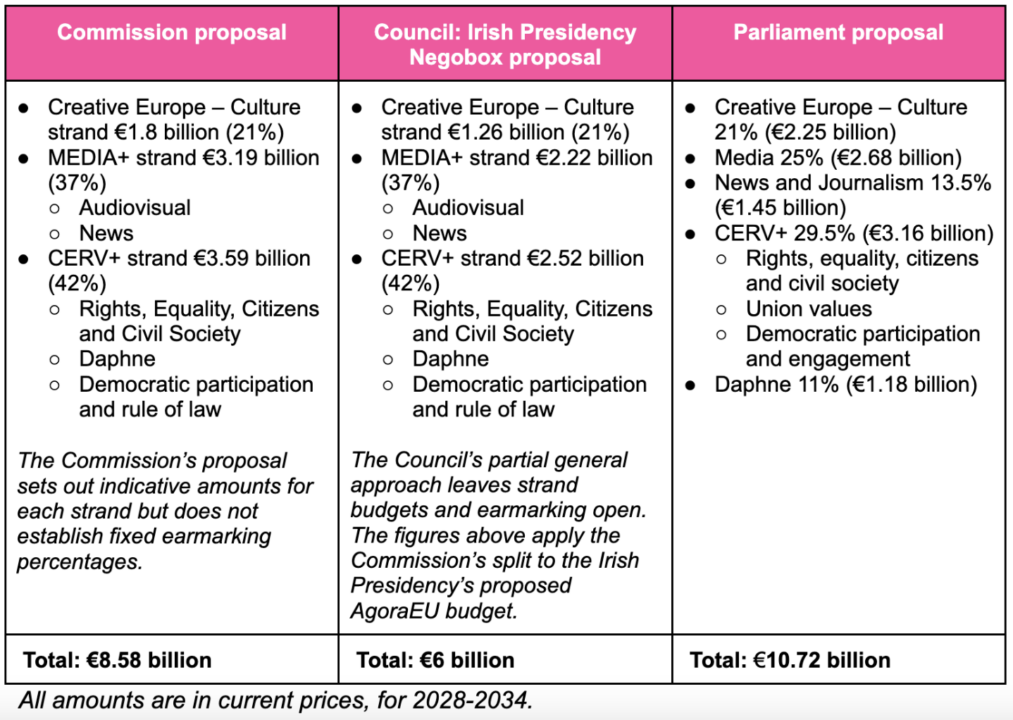
Much still depends on the overall budget. At Parliament’s proposed €10.72 billion, 21% would give Culture around €2.25 billion over seven years. The Commission proposed €8.6 billion for AgoraEU as a whole, and €1.8 billion for culture. In October, the Irish Council Presidency proposed disproportionate and unjustified cuts to AgoraEU that would reduce the programme’s envelope to €6 billion.
Below, you can compare the positions of the three institutions. The final AgoraEU Regulation will need to reflect a compromise between them.
What’s inside the Creative Europe – Culture strand?
The strand would support two types of actions: horizontal actions open across the cultural sectors and sectoral actions that respond to specific needs.
The horizontal priorities largely follow the Commission’s proposal, with some welcome additions. There is now a dedicated priority for artists and cultural professionals at risk of forced displacement or already displaced. Culture Action Europe has long been calling for such a scheme.
The Creative Europe – Culture strand would continue to support cross-border creation and cooperation, artist mobility, European networks and platforms for emerging artists, international cultural relations, the European Capitals of Culture, and the European Heritage Label. The compromise gives more attention to older people and people in rural areas under access to culture, and to the circulation of works in regional, minority and lesser-used languages. It also explicitly mentions access to finance for small and micro-organisations.
When it comes to specific sectors, the rapporteurs’ first draft report on AgoraEU gave music its own strand and books a separate objective. The compromise takes a more balanced approach. Parliament proposes targeted support, without singling out dedicated strands or specific objectives, for: 1) music, 2) books and publishing, 3) performing arts, 4) architecture and cultural heritage, and 5) other sectors where specific needs are identified. The new Annex I broadly follows the current Creative Europe annex. The clearest addition is a dedicated point for performing arts. Support for design and fashion are mentioned only in the annex under ‘other sectors’. We would have liked to see more explicit recognition of visual arts, crafts and design in the main provisions.
The compromise largely restores the definition of cultural and creative sectors used in the current Creative Europe programme, but there are a few changes to the list of sectors. The current wording is ‘audiovisual (including film, television, video games and multimedia)’. Parliament proposes ‘film and audiovisual sectors, video games’. This gives film and video games more visibility, though the wording is a little awkward: it reads as if both sit outside the audiovisual sector. Within the scope of ‘performing arts’, circus arts are now listed alongside theatre and dance. ‘Books and publishing’ becomes ‘publishing (books and written press)’.
The recitals recognise culture’s intrinsic and artistic value, link AgoraEU funding to the Culture Compass and recall the commitments on heritage in the Joint Declaration ‘Europe for Culture – Culture for Europe.’
What conditions would apply under the Creative Europe – Culture strand?
First of all, Parliament has strengthened the language on working conditions introduced by the Commission. The Culture strand ‘shall safeguard adequate, safe and fair working conditions for artists and cultural and creative professionals as well as fair and non-discriminatory remuneration, in compliance with applicable Union and national law and collective agreements’.
The relevant recital cites Articles 13 (freedom of the arts) and 31 (fair and just working conditions) of the EU Charter of Fundamental Rights, the principles of the European Pillar of Social Rights and the Copyright Directive. It also refers to a Council recommendation on decent working conditions for artists and other cultural and creative professionals. We are not aware of this document and wonder whether the intended reference is to Parliament’s 2023 resolution on the similar subject. Or to Council conclusions on supporting young artists.
We hope the EU Artists’ Charter will also be adopted in time in 2027 to be mentioned in the final AgoraEU Regulation.
The Creative Europe – Culture and Media strands introduce another important condition. They ‘shall support works demonstrating a substantial and identifiable creative human contribution’. Where AI tools are used in a supporting role to enhance human creativity, their use must be transparent and comply with EU law, in particular the AI Act and the Copyright Directive. We welcome the spirit of this amendment but are still unsure what constitutes a ‘substantial’ creative human contribution and how it will be checked. Will there be new requirements, indicators, declarations of honour or guidance for AgoraEU beneficiaries?
Culture Action Europe also welcomes language on inclusion, non-discrimination, equality, diversity and participation. Parliament proposes ‘specified incentives’ to improve access and participation for people with disabilities, people belonging to minorities and socially marginalised groups. Article 15 specifies that ‘accessibility and inclusion costs shall be reimbursed as actual eligible costs.’
A step backwards on international cooperation
The Creative Europe – Culture strand lists international cultural relations as a priority, which is very relevant in light of the upcoming revision of the EU Strategy on International Cultural Relations. Look at the eligibility rules of AgoraEU, though, and Parliament’s compromise goes in the opposite direction.
The difficulty lies in Article 16(2)(d) about the partners based in countries that do not participate in AgoraEU. The Commission proposal allowed an organisation in a non-associated country to receive funding where that funding was essential to the project. Parliament tightens the screws. A partner from a third country could take part only by exception, if its participation was strictly necessary and its country was listed in the work programme. Moreover, such partners would need to bear the cost of their participation. ‘Where it is in the Union’s interest, additional contributions from the external financing instruments may cover the costs of the participation of such legal entities.’
Take a company planning a co-production. It might have an essential artistic partner elsewhere in the world and still be unable to bring them into the project because their country is missing from the list. And even if the country is listed, the partner might be unable to afford to take part. Parliament’s compromise moves in the wrong direction and risks widening the gap between the open dialogue and reciprocity the EU preaches and the practical conditions for international cooperation it provides.
We have already seen the consequences under Creative Europe. The 2025 cooperation call completely excluded costs benefiting artists and professionals in ineligible countries. Cultural organisations should be trusted to choose the partners they need and be able to pay them for their work. Otherwise, the EU undermines its credibility when it says it wants to build lasting cultural partnerships abroad.
When it comes to how non-EU countries can join AgoraEU (Article 14), the basic arrangements are familiar from Creative Europe. Non-EU countries would make a financial contribution and participate under the terms that apply to them. Parliament adds safeguards on EU values and human rights. If a country breaches its commitments, the Commission could restrict or temporarily suspend its participation in specific actions. Alignment with the EU’s Audiovisual Media Services Directive remains a condition for participation in the MEDIA strand for candidate countries.
For countries already associated with Creative Europe, participation in AgoraEU would not carry on automatically but would require a new agreement covering the new programme.
Improving access to EU grants
Parliament proposes several practical changes to AgoraEU grants. For example, the compromise would allow AgoraEU grants to cover up to 100% of eligible costs, where appropriate. Pay attention to these two words: full EU co-financing is unlikely to be available for every project. We expect the work programmes and individual calls to specify where the 100% rate would apply.
Parliament also considers a two-stage application which would allow applicants to submit a short proposal before investing in a full application. MEPs want simpler lump-sum funding and lighter reporting. The compromise allows for higher pre-financing (more of the grant can be paid upfront) and says co-financing should not be required for funds redistributed through regranting schemes.
Alongside project grants, the compromise highlights cascading grants (through which a beneficiary passes funding on to smaller organisations) and multiannual operating grants.
The mention of multiannual operating grants deserves particular attention. The idea is to support an organisation and its ongoing work over several years rather than an individual project. Civil society organisations have long called for more of this kind of funding and for more coherent and streamlined rules for operating grants.
However, politically, operating grants are under pressure. The story began in early 2024, when right-leaning MEPs suspected that the Commission had used LIFE grants to get environmental NGOs to lobby Parliament on its behalf. Later, the Commission issued internal guidance to keep specific advocacy tasks out of grant agreements. A grant, for example, should never require an NGO to ask MEPs to back a particular amendment. On 18 November 2026, two MEPs from the EPP and ECR called for much tighter limits on operating grants, even though their review found no proof that the Commission had instructed NGOs to lobby.
In AgoraEU, the following amendment made it to the compromise recital: ‘In implementing the Programme, the Commission should ensure that funding fully respects the independence of civil society organisations and is not used by the Commission as an instrument to promote its own legislative proposals undermining the principle of separation of powers, while providing a necessary support to their capacity to operate independently, without any undue pressure or interference by the funding authorities on the implementation of the activities.’
Under Creative Europe, the grants for European cultural networks come close to operating support in practice, but they are formally action grants. Networks set out the activities they plan to carry out in work packages, so both sides know in advance what the grant covers.
For Culture Action Europe, as an advocacy organisation, it is very important that the EU funding we receive gives us the opportunity and freedom to advocate for the cultural sector, represent the interests of our constituency and choose the most appropriate means and tools to do so. Funding under AgoraEU should preserve this freedom for civil society organisations working in the public interest and allow organisations to carry out their advocacy work independently.
Parliament’s AgoraEU compromise also calls for closer links with Global Europe, Erasmus+, Horizon Europe, the Justice Programme, the European Competitiveness Fund and the National and Regional Partnership Plans.
We are especially interested in links with the European Competitiveness Fund, under which the InvestEU Instrument will sit. InvestEU now covers the Cultural and Creative Sectors Guarantee Facility — a very successful programme that covers banks’ risks when they lend money to creative businesses.
Under Article 15, while the InvestEU instrument is part of the European Competitiveness Fund, AgoraEU would have to set aside money from its own budget to back any guarantees InvestEU uses for the cultural and creative sectors. That also explains why Parliament added access to finance for small and micro-organisations among the Culture strand’s priorities. It also raises a budget question: how much would AgoraEU set aside for guarantees, and how much would that leave for grants?
On additional revenue, the compromise argues that more resources are needed in light of the concentration of power in digital markets, but the earlier proposal to direct digital fines to AgoraEU has dropped out.
New institutional setup
Parliament has tried to clarify what will happen to the Creative Europe Desks. Article 10a says the AgoraEU Desks would build on existing [Creative Europe] programme desks and [CERV] contact points and ensure that services continue without interruption. The Agora EU Desks ‘shall be funded by the financial envelopes of the respective strands as per need.’ That gives the impression that the existing Creative Europe Desks and CERV National Contact Points would carry on as they are. Yet the same article also says that Member States and participating third countries would establish AgoraEU Desks in cooperation with the Commission, in line with national law and practice. So would the existing desks and contact points be merged, or would they continue separately under a new name? We still need an answer.
Parliament also proposes a new body under Article 10b, the AgoraEU Dialogue Platform. It’s a way for civil society to have a better say in the implementation of AgoraEU. The platform would give beneficiaries, AgoraEU Desks and other stakeholders a place to exchange experiences, good practices and challenges in implementing the programme. The recital clarifies that the platform may be organised in configurations reflecting the different strands of the Programme. The Commission should consult the Platform as part of the qualitative evaluation of the Programme, and must take the Platform’s findings into account when preparing work programmes.
The Parliament also wants a stronger say in AgoraEU. For example, it proposes that work programmes be adopted through delegated acts, which gives Parliament and Council the right to object after the Commission adopts them, preventing them from entering into force. Under the current Creative Europe programme, work programmes are adopted through implementing acts: representatives of Member States vote on the drafts in the Creative Europe Committee. Parliament and the Council can ask the Commission to review a draft if they consider that it exceeds its implementing powers, but they cannot block its adoption.
What’s next?
Following the vote in the CULT and LIBE Committees, the AgoraEU report will be voted on in the European Parliament’s plenary in the coming weeks.
While the Commission’s proposal and the Council’s position were relatively conservative, Parliament’s compromise has created space for new ideas. Among the positive changes are earmarked funding, stronger provisions on working conditions, a new priority for artists at risk and simplified financial requirements. Concerns remain about the restrictive provisions on third-country participation. Much will also depend on implementation, for example, how provisions on working conditions or up to 100% financing rate will be applied in practice. The text would also benefit from ironing out a few minor inconsistencies elsewhere, which likely arose in the difficult process of working through hundreds of amendments.
Meanwhile, the main battle over AgoraEU is unfolding in the Council, which has yet to agree on how much funding AgoraEU and other programmes will receive under the next MFF. Good proposals will remain on paper if the Council cuts AgoraEU’s budget by 30%, as suggested in the Irish Presidency’s negotiating box in October. It is crucial to mobilise at the national level and engage national governments, particularly in frugal Member States (Austria, Belgium, Denmark, Finland, Germany, the Netherlands, Sweden) to prevent cuts to AgoraEU.
Parliament’s position provides a good basis for further interinstitutional negotiations between Parliament, Council and Commission in 2027. MEPs brought forward many ideas that the cultural sector has long advocated for — we hope that as many as possible will survive the negotiations and be retained in the final AgoraEU Regulation.
Photo credit: Luis Hidalgo photography, Brussels 2026