What We Talk About When We Talk About Socially Engaged Arts
Written by Sara Bandinu, Advocacy campaign coordinator at Culture Action Europe.
Eleven women with first-hand experience of domestic abuse and homelessness come together over a series of workshops to co-create and perform a play based on their lived experiences. The play is then performed live for an audience of key stakeholders, including experts, government officials, representatives from statutory bodies, elected officials, and charities. Following the performance, the actors and audience members collaborate with a panel of policymakers to co-author three key policy proposals addressing the issues raised in the play.
Far from being a speculative exercise, this project really happened and actually achieved those policy outcomes. It was carried out in early 2025 by the UK-based charity organisation Arts & Homelessness International, specialised in promoting positive change in the field of homelessness through arts and creativity. It is one of many implementations of the widely established practice of Legislative Theatre, a participatory theatre form developed in the 1990s by Brazilian playwright Augusto Boal, grounded in the pedagogical theories of Paulo Freire.
This is a clear example of what we could refer to as socially engaged art: poetic, yet actionable and political as well. While traditional studio-based practices (such as sculpture, film, painting, and video) have shaped a conventional sense of what art should look like and can themselves remain deeply political even when not explicitly centred on social engagement, this work operates somewhat differently by intentionally extending beyond those familiar frameworks. In this sense, socially engaged arts can be defined as a set of collaborative, community-centred practices in which artists and participants co-create artistic responses to social, environmental, and political issues. Instead of focusing on art as a material creation or experience presented to audiences, socially engaged arts emphasise process, dialogue, and collective action, fostering local ownership, social cohesion, and active citizenship through art. And they do so in a number of ways: for instance, by placing unprecedented trust in co-creation and embracing the absence of guaranteed success, as well as by creating space for shared decision-making, fostering trust, redistributing power, and inviting community members to imagine and author visions of the future.
Socially engaged arts has increasingly become the umbrella term used to describe a wide constellation of community-based artistic approaches. These include community arts, participatory arts, collaborative and co-created practices, social practice, public art, and artivism to name a few. Together, these approaches share a commitment to working with communities, shaping cultural processes collectively, and responding to the social, political, and environmental conditions in which they are embedded.
Nonetheless, the ambiguity that surrounds these types of practices does not stem from conceptual weakness, but from this very hybridity. Socially engaged arts push us, intellectually and ethically, to familiarise ourselves with complexity because they unfold across disciplines, formats, and forms of knowledge, blurring distinctions between art and life, aesthetics and ethics, creation and participation. They train us to inhabit this porosity, and that is no small thing.
This becomes evident in the Swiss town of Vevey, where every two years an art biennale takes place within the local initiative foodculture days, dedicated to “(re)discovering the multiple meanings and functions of food in everyday life.” In that occasion, artists, scientists, farmers, cooks, winemakers, anthropologists, philosophers, activists, ecologists, gardeners, local experts, elders — alongside vegetal, mineral, animal, fungal, and bacterial forms of intelligence — come together as cultural producers. Food becomes, at once, a research subject, a material, a relational device, and a tool of resistance, making visible the productive ambiguity through which socially engaged arts take shape.
And this is not the only stimulus they introduce into our ways of thinking. Author and curator Nato Thompson has devoted much of his work to illustrate how socially engaged arts, with their emphasis on participation and the social, can be understood as a necessary reaction to the alienating effects of media saturation and manipulative culture-making of capitalism. By creating experiences that cannot be easily bought or sold in a world where almost nothing escapes commodification; by carving out spaces in which care, solidarity, and shared authorship temporarily prevail over entertainment; and by privileging lived experience over representation, these practices rebuild social bonds within an increasingly atomised culture. They operate as interstices of resistance.
And we need to talk about them, because socially engaged arts are growing and constantly reshaping themselves in response to the needs of our time. They offer grounded, relationship-centred approaches that spark generative and emergent ways of responding to a moment shaped by widespread precarity and overlapping crises.
Other examples include the many grassroots movements that have been addressing questions of spatial and social justice as a response to the ongoing housing crisis. Where industrial archaeology has deeply altered urban landscapes, and where market logics have deserted or gentrified entire areas, socially engaged arts organisations are increasingly reclaiming these spaces and restoring them to their communities. Initiatives such as Largo Residências, which in Lisbon turned the former abandoned Miguel Bombarda Hospital into a cultural and community centre, or The Collective, based in Sofia, which has transformed neglected urban sites into vibrant public spaces since 2020, are emblematic case studies.
These initiatives represent the political act of reclaiming a common good and reopening it inclusively to communities previously excluded. Additionally, by hosting cultural programmes, workshops, festivals, and other forms of social exchange, they create oases: spaces in which communities feel safe enough to collectively explore who they are and who they might become. They not only combine new forms of living, but they also activate those who inhabit these spaces to generate new ways of being in the world.
So, what do we talk about when we talk about socially engaged arts?
What emerges from these few examples is a shared orientation that frames socially engaged arts as practices rooted in communities, structured around participation, and attentive to process as a site of meaning in itself. They unfold across artistic, social, and political registers, drawing strength from their hybrid nature. By working within, and often against, the conditions that shape contemporary life, they seek not only to respond to social challenges, but to gently short-circuit the logics that sustain them, creating room for collective agency, care, and transformation.
This reflection intends to offer a frame to spark an ongoing conversation on socially engaged arts today: one we intend to nurture and enrich by collecting grounded stories of change-making. We will do so through a podcast, where each episode will give space to socially engaged practitioners to share their personal stories of impact. If you would like to embark on this journey with us and join the conversation, you can listen to the first episode here.
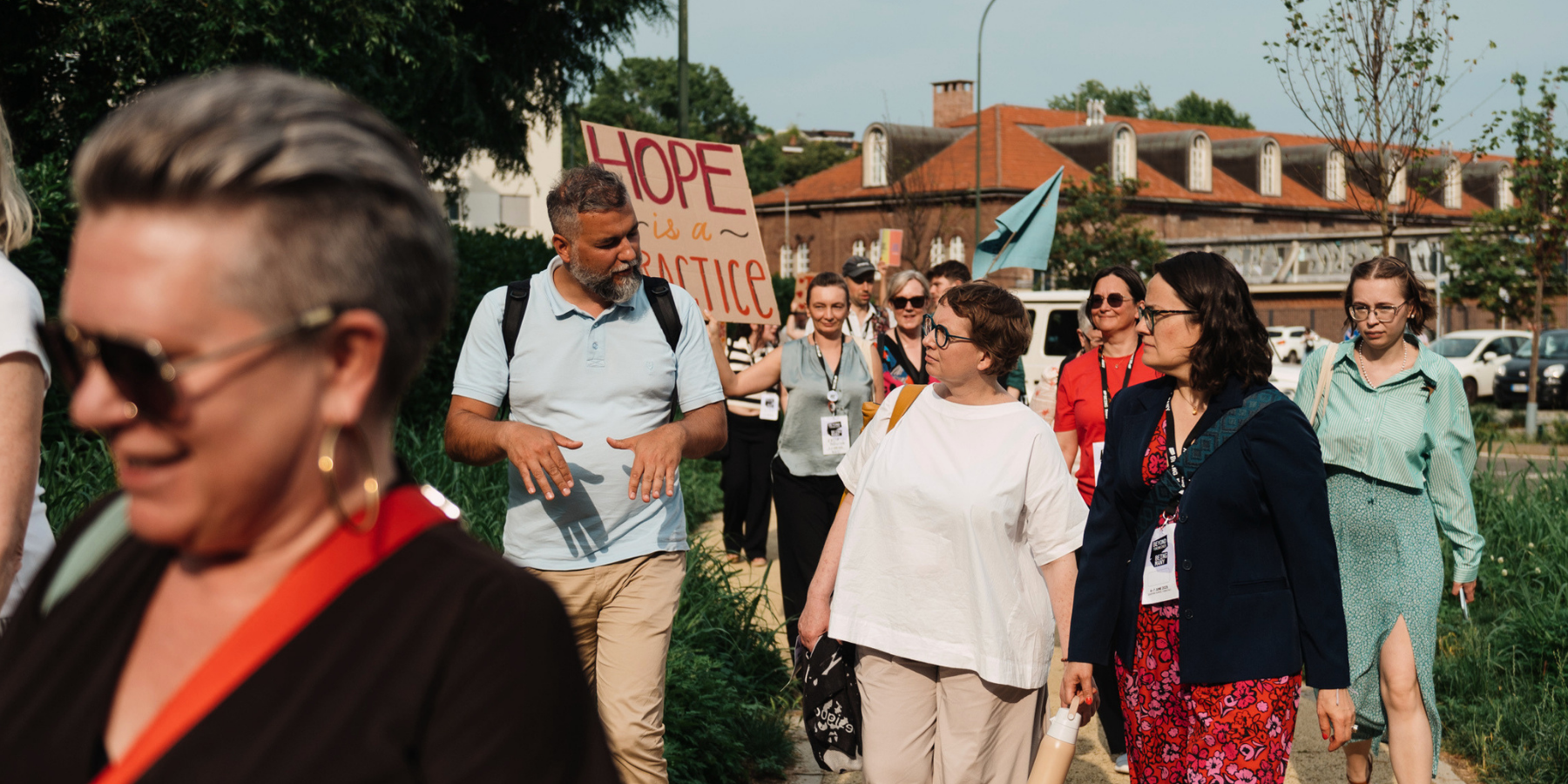
Image credit: Andrea Guermani, Alliance for Socially Engaged Arts | Torino, 2025.