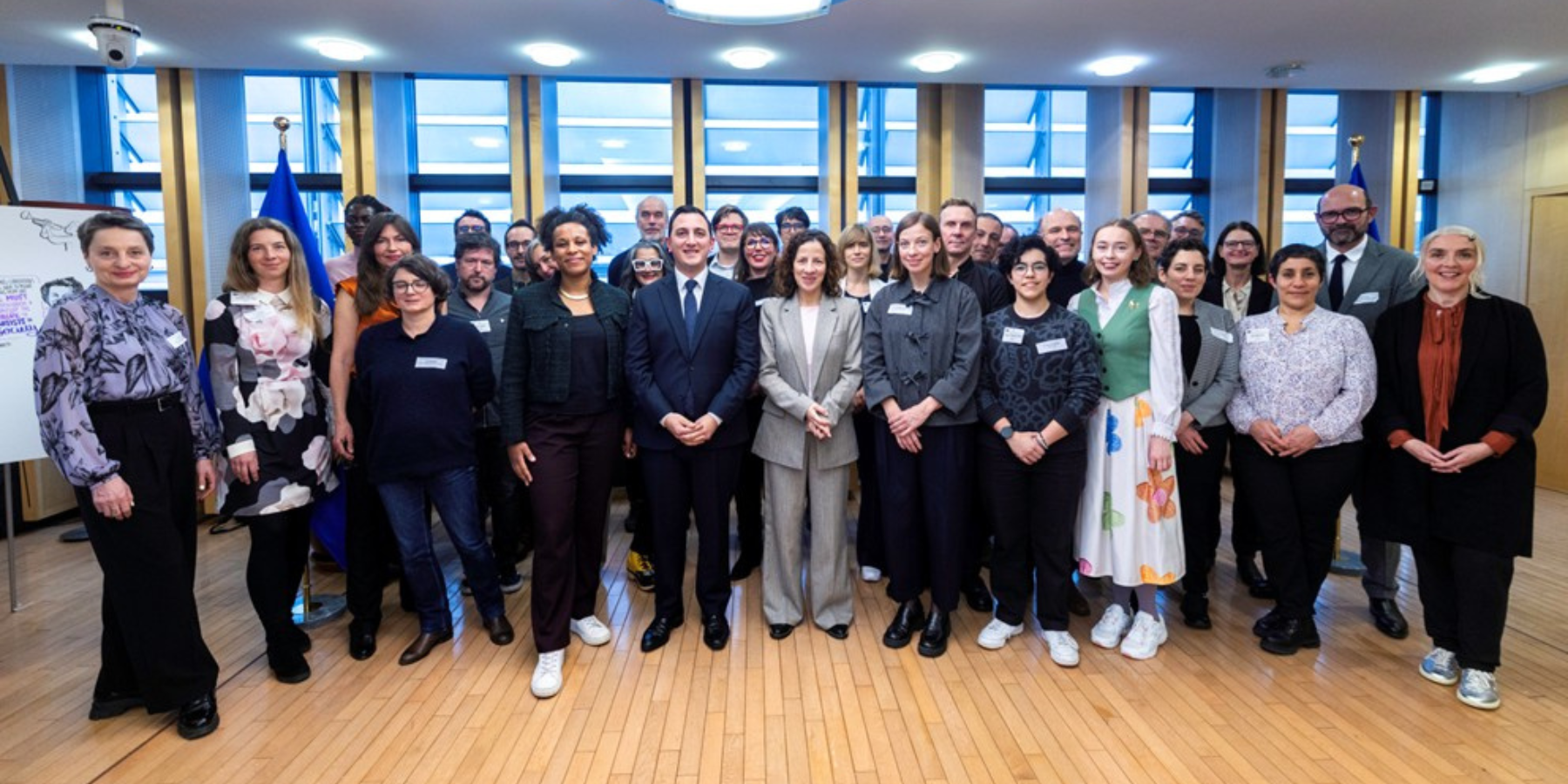
Recap of the High-Level Round Table on Artists’ Working Conditions
On 8 December 2025, the European Commission organised a High-Level Round Table on Artists’ Working Conditions. The meeting was hosted by Executive Vice-President for Social Rights and Skills, Quality Jobs and Preparedness Roxana Minzatu and Commissioner for Intergenerational Fairness, Youth, Culture and Sport Glenn Micallef.
Welcome remarks were also delivered by Members of the European Parliament: Nela Riehl, Chair of the Committee on Culture and Education (CULT), and Li Andersson, Chair of the Committee on Employment and Social Affairs (EMPL), as well as by the Commission’s Georg Häusler, Director for Culture, Creativity and Sport, and Denis Genton, Director for the European Pillar of Social Rights and Strategy.
The round table had been announced in the Commission’s response to the European Parliament’s 2023 resolution on working conditions in the cultural sector.
In total, 25 organisations took part, including eight social partners (organisations representing employees and employers in the cultural sector) and several European cultural networks. In addition, three artists from France, Sweden and the Netherlands were invited to share first-hand their experience of working in the cultural sector.
What did participating organisations discuss?
Firstly, several social partners stressed the importance of strengthening social dialogue and collective bargaining, and expressed their readiness to work towards a framework agreement for the sector, if needed. (An autonomous framework agreement is an EU-level deal between workers’ and employers’ organisations that sets common principles and minimum standards on a specific labour issue, where the parties involved agree to implement it through their member organisations.)
Secondly, many organisations underlined the need for better regulation of artificial intelligence. They called for an opt-in system under which tech companies must obtain permission from rightsholders before using their works for AI training, and for full implementation of the Authorisation Remuneration Transparency principle. Many participants expressed high hopes for the forthcoming revision of the Copyright Directive.
There were calls to ban buyout contracts (a deal where a creator gets a one-off fee in exchange for giving up all or most rights to future uses and revenues from their work). Many organisations highlighted the need for increased public funding at EU, national, regional and local levels, and for social conditionality linked to this funding, meaning that beneficiaries of public grants should commit to fair pay, fair practice and decent working conditions. Sector-specific concerns were also raised, including the protection of journalists, fixing streaming loopholes and guaranteeing statutory remuneration rights for audiovisual authors, as well as securing performers’ neighbouring rights for the duration of their lifetime.
Beyond insufficient remuneration for artistic work, including unpaid preparation time, many participants stressed gaps in social protection, especially in cases of sickness, unemployment, pregnancy and maternity leave.
Culture Action Europe was represented by its Head of Policy, Luiza Moroz. Her intervention focused on the proposed EU Artists’ Charter, an idea put forward in the Culture Compass and already conceptualised by Culture Action Europe and Creative FLIP in the discussion paper ‘Towards the Culture Compass: a Sector Blueprint’. Luiza underlined that:
- The Charter should be endorsed as broadly as possible: by EU institutions, Member States, social partners, networks, employers and cultural operators who work with artists or commission their work. Its legal form should therefore match its political ambition. She suggested that the Charter be adopted not only as a Commission communication, but also strongly supported by Member States, for example through Council Conclusions.
- Culture Action Europe sees the Charter as a stepping stone towards future binding measures, including a possible Directive on working conditions in the cultural sector.
- The process for developing the Charter should be horizontal and open. It should involve the launch of an expert working group to draft the text, with the participation of civil society and several rounds of consultation.
- The Charter needs practical monitoring tools: public reporting on its implementation and on progress towards its indicators, clear and accessible information on who has endorsed the Charter, and a regular stock-taking conference. The Charter should also be backed by funding to support training for artists on their rights and broader capacity-building.
- The Charter should offer a concrete way to implement the principle of fair working conditions set out in the AgoraEU proposal. One practical option would be an annex on fair practice that beneficiaries of EU funding commit to when signing their grant agreements.
- Content-wise, the Charter should start with a clear definition of artists and workers in the cultural and creative sectors. It should then be structured around at least four core dimensions of fairness: fair pay; fair labour relations for all types of contracts; fair social security; and fair taxation. Each of these should take into account the specific realities of artists and cultural workers, including international mobility, artistic freedom and the impact of artificial intelligence.
- Each topic covered by the Charter would follow a common template. For every theme, the Charter would set a clear priority explaining how it improves working conditions and contributes to a fairer system. It would highlight concrete good practices from Member States, refer to relevant EU legislation and national legal frameworks, and include indicators at EU and national levels to monitor progress over time.
Read more about the Charter in the discussion paper ‘Towards the Culture Compass: a Sector Blueprint,’ developed collaboratively by Culture Action Europe members.
In their closing remarks, the Commissioners reaffirmed the commitment to delivering tangible improvements to working conditions at EU level, starting with the preparation of the EU Artists’ Charter. Culture Action Europe is ready to cooperate and actively contribute to the drafting process.