Calibrating the Needle: Steps Forward with the Culture Compass
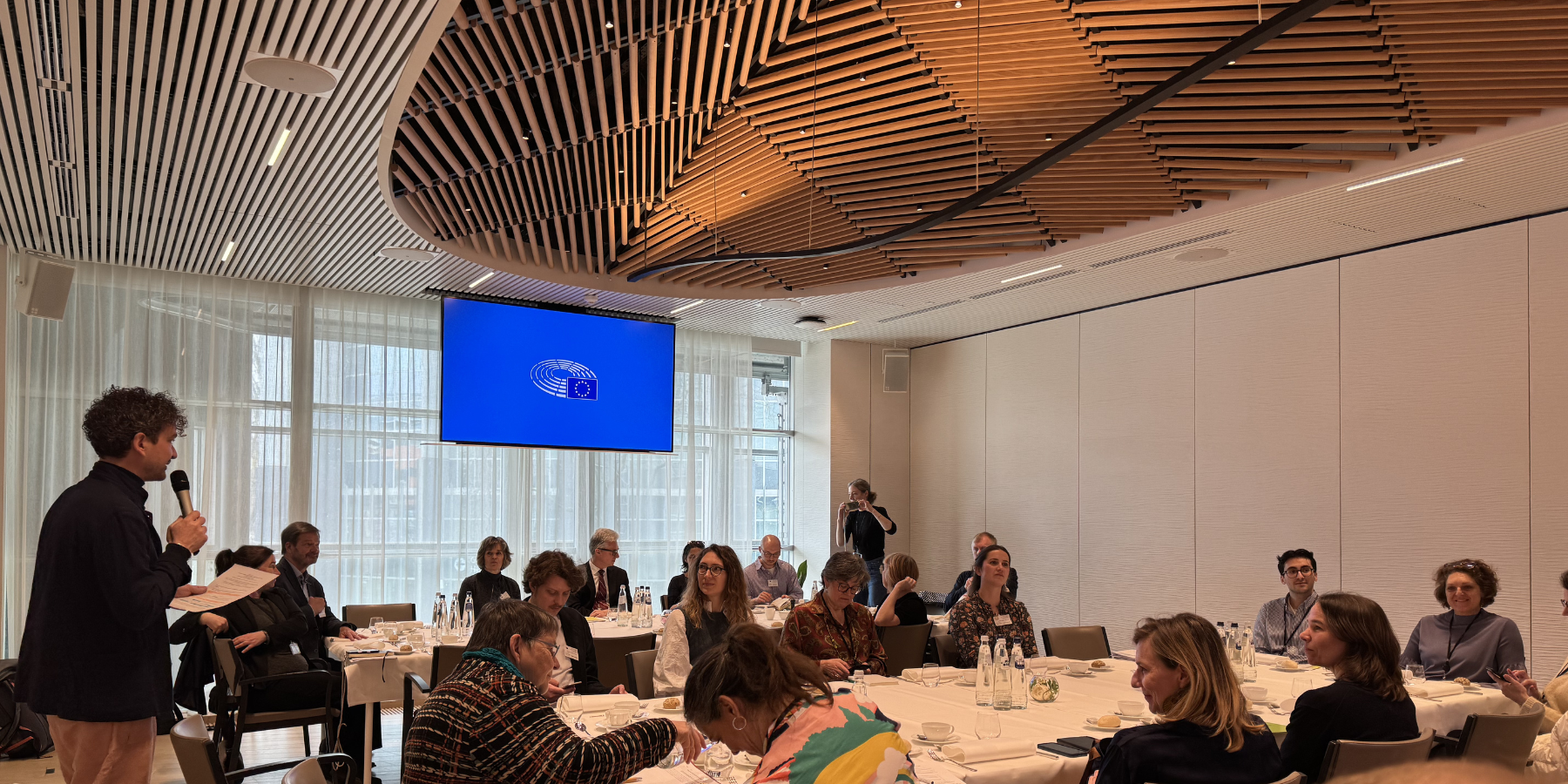
Yesterday in the European Parliament, Culture Action Europe (CAE) and the office of MEP Nela Riehl co-hosted a policy lunch to bring together EU decision-makers, cultural networks, civic and democracy organisations, and foundations to discuss how to move the Culture Compass from a promising political framework into a living tool for action.
While the Compass has been broadly welcomed across institutions and the wider cultural sector, the discussions during the lunch showed the strong consensus that its real test now lies in implementation: in the design of the Structured Dialogue, the future EU Cultural Data Hub, the State of Culture report, the AI Strategy, and the wider policy architecture that will shape the next Multiannual Financial Framework (MFF). As Georg Häusler, Director for Culture, Creativity and Sport at the European Commission, put it, “The work of the Compass only started with its adoption.”
In his opening remarks, Lars Ebert, Secretary General of CAE, situated the moment within a longer process of advocacy and collective work of the sector. From the Cultural Deal for Europe mission letter, to the State of Culture report, to the Sector Blueprint for the Culture Compass that emerged from consultations during CAE’s BEYOND 2025 gathering, the collaborative work of the cultural sector has led to this moment, and, as Lars says, the Compass is “something that we can, and want to, work with.”
Throughout an afternoon of discussion, primarily focused on the voices of representatives of cultural networks, organisations and civil society, some four key takeaways emerged from the conversation.
Values and Cultural Rights
One of the strongest messages of the day was that cultural rights must not be treated as a niche theme within one part of the Compass, but as a universal principle that runs across all of it. Several organisations stressed that if cultural rights are essential to democratic life, then they must shape the design of the Compass’ actions as a whole, from participation and access to data, funding, and implementation.
This point was made especially clearly by Opera Europa, which reminded the room that “cultural rights, like all human rights, are universal, inalienable and interrelated.” Their intervention pushed the conversation beyond abstract support for rights and toward practical questions: what would it mean to apply a cultural rights lens to the EU Cultural Data Hub, to the Commission’s future State of Culture report, and to the way the Compass is evaluated over time?
Others connected this directly to democracy. The European Cultural Foundation argued that the link between culture and democracy must be strengthened, including in relation to the European Democracy Shield. They also stressed people must be empowered not only to consume culture, but also to take part in shaping it. As they put it, citizens must be supported “not only to access culture, but also to create and express themselves freely.”
The question of rights was also raised in relation to the digital realm. Michael Culture Association argued that digital cultural rights should be mainstreamed across the Compass, especially as AI and platform logics increasingly shape how culture is created, shared, and governed. In their view, protecting democracy and diversity in the digital realm is not separate from cultural policy, but one of its central tasks.
At the same time, participants insisted that rights-based implementation must be even more concrete. Better access to culture for people with disabilities was highlighted as a clear area where the EU can and should act more decisively. And in discussions on the proposed European Prize for Performing Arts, multiple voices stressed that new initiatives must build on existing frameworks and recognise the full ecology of the sector, including independent actors, not only major institutions.
Taken together, these interventions made one point unmistakable: if the Compass is to stand for European values, then cultural rights must become one of the methods through which those values are implemented.
Artists and People
A second major thread of the conversation focused on the people who make culture possible: artists, cultural workers, learners, participants, and audiences. The conversation repeatedly returned to the need for implementation that is grounded in lived realities, especially the realities of precarious work and unequal access for so many across the sector.
The proposed EU Artists Charter was discussed as a key opportunity, but also as a test. Many participants stressed that any future framework must do more than symbolically support artists; it must actively safeguard artistic freedom, experimentation, and the conditions that make creative work possible. The European Dance Development Network was particularly clear that artistic freedom is inseparable from experimentation, and that experimentation itself depends on working conditions and on the ability of communities to encounter and take ownership of artistic work. The urgency of this issue was reinforced by the European Theatre Convention, which noted that attacks on artistic expression are not hypothetical but ongoing, saying they hear “weekly if not daily about attacks on premiers or performances.”
Participants also stressed that the Compass must speak more clearly to those who are often under-recognised within policy decisions. The European Concert Hall Organisation and the European Choral Association emphasized the importance of participatory cultural practice, such as collective singing, arguing that the benefits of such activities extend far beyond the cultural field alone and into that of health, well-being, education, and resilience. They also urged that the language of the Compass’ actions should make people feel “addressed” and included, especially those who do not identify with a purely economic or market-based framing of culture.
Access to arts education emerged as another major concern. The Association Européenne des Conservatoires warned that music and arts education are slowly disappearing from primary and secondary schools, describing this as “a disaster in slow motion.” ELIA added that access to arts education remains deeply unequal across Europe, and that without it, ambitions around diversity, participation, and future skills pipelines will remain limited. Calls were also made to reintroduce and strengthen STEAM approaches, recognising that artistic and cultural learning are central to creativity, innovation, and democratic imagination.
A final key point, echoing throughout the afternoon, was that implementation must properly reflect independent artists and workers, not only institutional actors. Attendees reminded EU institutions that artists often work across borders, outside large structures, and under fragile conditions. If the Compass is serious about artists and people, then its actions must reflect the full diversity of the sector’s realities.
Competitiveness, resilience, cohesion
Again and again, speakers challenged the idea that competitiveness can be approached through market logic alone, arguing instead for a broader vision of resilience, one that includes cultural rights, democracy, social cohesion, sustainable careers, and human-centred technological development.
One key advocacy point was the need for the European Competitiveness Fund to explicitly mention the Culture Compass, ensuring that culture is not sidelined in broader EU economic and strategic frameworks. The discussion on AI Strategy was especially important here, with many in the room speaking to the importance of culture not being absent from these debates, especially when digital transformation, big tech power, and democratic vulnerability are reshaping Europe’s social fabric.
The European Parliament’s office had already raised concerns about coherence across parallel files, such as from copyright to AI in the cultural and creative sectors. The discussion built on that by calling for a holistic approach to AI, one that starts from the needs of cultural and creative workers rather than from technology itself. As Michael Culture Association put it, “We shouldn’t go tech for tech’s sake.” AI, they argued, must support rather than replace cultural professionals, and digital governance must protect diversity, rights, and democracy.
Questions of resilience also extended to careers and labour conditions. The European Association of Independent Performing Arts raised the need for much greater support for early career transition and retraining, especially in fields such as dance where careers are often physically limited in duration. This was a powerful reminder that if Europe is serious about cultural labour, it must also care for workers beyond moments of visibility and success and invest in structures that allow people to continue building lives in and around culture.
The section also returned to mobility and access. The European Cultural Foundation stressed that everyone should have the opportunity to experience cultural mobility, not only established professionals. Mobility was framed as part of how people build a meaningful relationship to and within Europe. Cultural exchange, study, travel, and creation across borders all contribute to a sense of belonging and shared public space.
International Cultural Relations
Several interventions stressed that the updated International Cultural Relations (ICR) strategy must genuinely involve the global cultural sectors and those already working in international partnerships. There was a strong sense that Europe should approach ICR as a way of building reciprocal relationships. The Goethe-Institut Brussels, which warned against reducing culture to “soft power” or strategic messaging, described ICR as a practice of co-creation, local needs, finding ways to work together, and building trust. Culture’s strength in this process lies not in helping create common spaces with partners.
Others emphasised the importance of pace and political seriousness. The discussion raised concerns that Europe has already spent too long revisiting and revising ambitions while geopolitical realities continue to shift rapidly. It was suggested that ICR actions should embrace and build upon existing initiatives in the cultural and creative sectors, and make better use of the networks, knowledge, and infrastructure already present across and outside of Europe.
Participants argued that ICR actions should help build bridges for Europe globally, while also raising culture to a higher political level within EU external action. If handled well, the Compass can help strengthen the argument that culture is not peripheral to international affairs, but part of how Europe builds meaningful and sustainable relationships in the world.
Implementation, data, dialogue, and the bigger picture
Lastly, the conversation brought together several cross-cutting issues that may prove decisive for the Compass’ success.
There was a clear call for stronger recognition of existing initiatives and frameworks that already embody the Compass’ ambitions. Europa Nostra argued that the European Heritage Label should be much more visible within this conversation, especially given its role in fostering belonging and shared European meaning. More broadly, several organisations stressed that a holistic understanding of culture must better integrate heritage, education, participation, and rights rather than treating them as separate worlds.
Many interventions returned to the role of civil society participation. This was discussed not only in relation to the Compass, but also in the context of the Multiannual Financial Framework (MFF). The feeling in the room was that civil dialogue needs to be mainstreamed throughout future implementation processes, especially if the EU wants the Compass to remain credible, responsive, and connected to realities on the ground.
In the closing reflections, Luiza Moroz, Head of Policy at Culture Action Europe, argued that the proposed Structured Dialogue in the Culture Compass is “not only a flagship action. It is condition and it should accompany all 20 flagship actions.” If done well, Structured Dialogue could become a method for implementation across the whole Compass, rather than a standalone exercise.
A number of organisations stressed that cultural networks already hold significant knowledge and data that could contribute meaningfully to the EU Cultural Data Hub. Speakers argued that the Hub must be designed with a broader understanding of evidence. The Alliance for Socially Engaged Arts called for mixed-method approaches that can better demonstrate the social, civic, and democratic impact of socially engaged arts, rather than relying solely on quantitative indicators. The point was echoed across the room: what gets measured will shape what gets valued.
Finally, the conversation returned repeatedly to the question of resources. The Parliament and the sector alike stressed that ambition must be backed by funding in the next MFF, particularly through the AgoraEU programme. The challenge now is to secure the budgetary conditions that will make implementation possible. As Matondo Charlotte Bechert, speaking on behalf of MEP Riehl, warned: “If we don’t put money behind the ambitions, there is little worth to those ambitions.”
Next Steps
Alongside these thematic discussions, the European Commission shared its hope that the Joint Declaration could be signed by the summer, with the possibility of further institutions joining later in the year, which would send an important political signal.
The next phase will require coherence across policy files, meaningful participation from civil society, stronger integration with wider EU priorities, and sustained pressure around the MFF. From Culture Action Europe’s side, we are activating four action groups on the four flagships within the Culture Compass that we see as most pressing for advocacy at the moment: Artistic Freedom, AI and Digital, Working Conditions, and International Cultural Relations. The conversations that took place at the Parliament yesterday will also inform the work of these action groups.