
Reading between the strands: AgoraEU after Parliament and Council
AgoraEU, the main EU programme for culture in 2028-2034, is taking shape as the EU institutions set out their positions. Culture Action Europe explains how.
The law that will govern AgoraEU is shaped by three EU institutions: the European Commission (proposes the law), the European Parliament (amends and adopts it on behalf of EU citizens), and the Council of the EU (amends and adopts it on behalf of the 27 Member State governments).
The Commission tabled its proposal last July, merging Creative Europe and the Citizens, Equality, Rights and Values Programme (CERV) into AgoraEU. Since then, we have been waiting for the Parliament and the Council to formulate their respective positions. In May-June 2026, almost one year later, things are starting to crystallise.
Culture Action Europe has already analysed the Commission’s proposal. A quick recap before turning to the Parliament and Council: the Commission’s structure for AgoraEU looks like this:
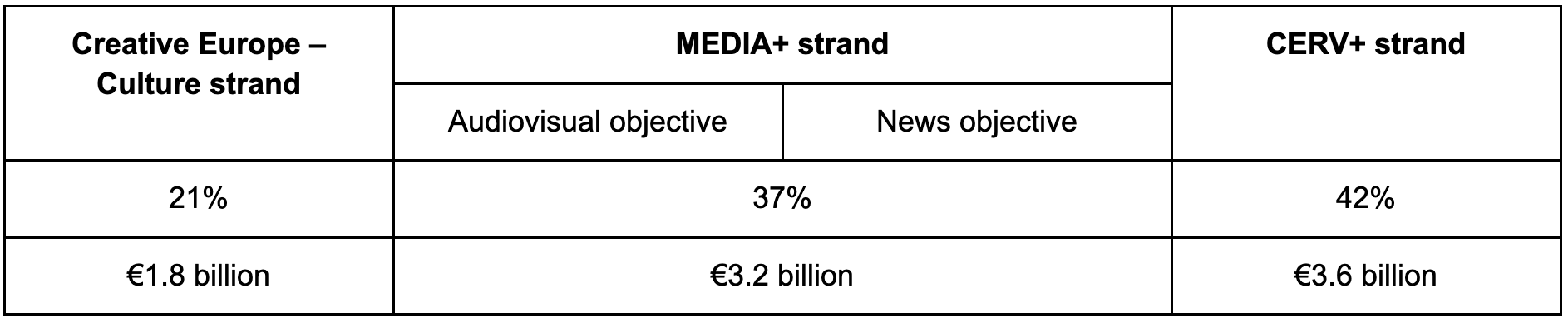
Table: The budgetary allocation outlined in the AgoraEU proposal of the European Commission, including a total indicative budget of €8.6 billion for the programme.
Parliament’s position on AgoraEU
The draft report on AgoraEU by rapporteurs Emma Rafowicz (S&D, France) and Alice Kuhnke (Greens, Sweden), dated 7 May 2026, was made publicly available on 18 May.
Let’s start with the good news. The Parliament’s report introduces many of the changes the sector—and Culture Action Europe in particular—has been calling for. The most notable proposals cover:
- a dedicated objective to protect artists at risk (amendments 11, 86);
- the idea to supplement AgoraEU funding with fines imposed by the Commission on tech companies for violations of EU digital legislation (amendments 48, 147);
- social conditionality: ‘support shall be provided exclusively to activities that guarantee decent and safe working conditions, together with fair and non-discriminatory remuneration’ (amendments 10, 91);
- focus on the inclusion and greater participation of persons with disabilities (amendments 13, 84, and 128);
- more clarity on the AgoraEU Desks: in countries where a Creative Europe Desk and a CERV Contact Point have been established, the programme should support their continuation. Desks and Contact Points should receive the funding from the strands corresponding to their areas of competence (amendments 52, 136);
- more accessible funding: operating grants (which, unlike actual-cost grants, support the organisation itself rather than a single project), a two-stage application process, and lighter reporting requirements (amendment 49);
- a possible 100% co-funding rate, meaning EU funds could cover the full cost of a project—currently cultural organisations are required to provide some costs for the project themselves, which often excludes smaller organisations (amendment 159);
- greater use of funding for third parties, where a primary beneficiary re-grants part of its funding to smaller organisations on the ground (amendment 158);
- annexes specifying concrete funding lines and indicators per strand;
- an explicit reference to the Culture Compass to strengthen the complementarity between the strategy and the funding programme (amendment 10).
Another important proposal is a strong focus on protecting human authorship from AI (amendments 9, 91, 92, 102). Support would be restricted to works and performances based on a substantial and identifiable creative human contribution. How ‘identifiable’ will be checked in practice is less clear, since existing AI detectors don’t offer full guarantees. ‘Where artificial intelligence tools are employed in an auxiliary capacity, they shall serve to enhance human creativity, be deployed with full transparency, with the consent of the contributing artists and cultural and creative professionals, who shall be remunerated appropriately,’ the report says.
The rapporteurs also propose establishing the AgoraEU Dialogue Platform (amendments 53, 137, 177, 178). It is a forum for beneficiaries and other stakeholders to exchange experiences and good practices, discuss policy developments, and reflect on AgoraEU’s implementation. The Commission will consider the findings of the Platform in the preparation of the annual work programmes. The Platform should also be consulted as part of AgoraEU’s qualitative evaluation.
These changes are quite ambitious and could address issues the cultural sector has long been raising.
That said, the same report also introduces a more far-reaching structural change, which raises complex questions for the cultural sector as a whole. According to the rapporteurs, the programme structure would look like this:
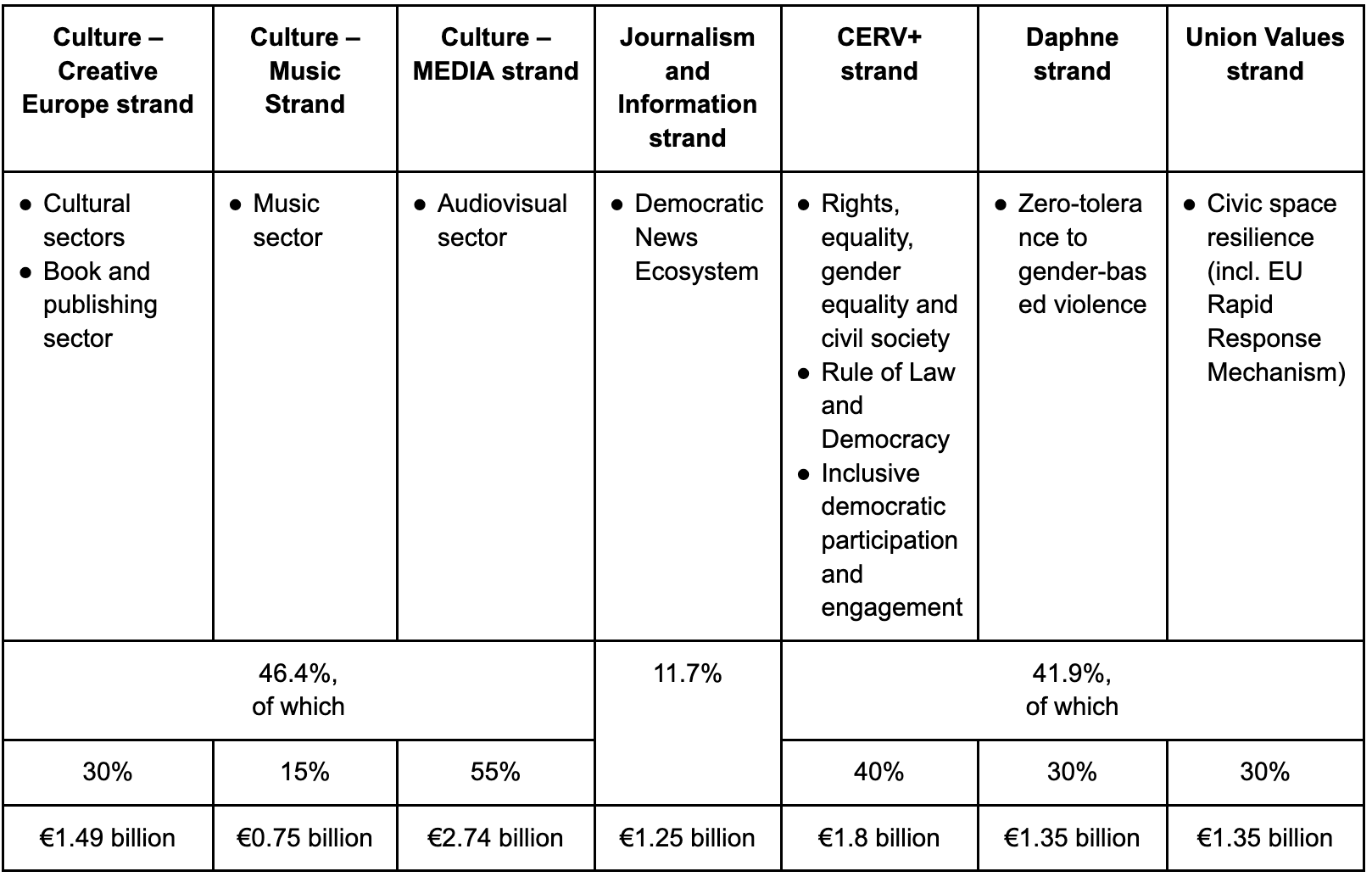
Table: The budgetary allocation outlined in the European Parliament’s position on AgoraEU, including a total financial envelope of €10.72 billion (+25% increase when compared to the Commission’s proposal).
Instead of three strands proposed by the Commission, the Parliament proposes seven. The ‘culture family’ of AgoraEU now includes:
- Culture – Creative Europe, which contains two specific objectives: a) Cultural Sectors and b) Book and Publishing Sector;
- Culture – Music;
- Culture – MEDIA, which the report places separately from Journalism.
The split within the ‘culture family’ is 30% for Culture (€1.49 billion), 15% for Music (€0.75 billion), and 55% for MEDIA (€2.74 billion). Altogether, they are earmarked at 46.4% of the whole programme.
Culture Action Europe notes that the Parliament recognises the cultural and artistic character of the audiovisual sector by giving MEDIA a ‘Culture’ prefix and placing it alongside the other cultural strands. We also support earmarking between strands because this would remove the annual competition over budget and provide greater predictability for the sectors.
At Culture Action Europe, we empathise with some cultural sectors gaining greater visibility and funding, but we are concerned that the proposed structure sidelines other sectors and undermines the cross-sectoral nature of cultural cooperation.
First, the logic of selection in the Parliament’s report is unclear: why does one sector receive a whole strand, another just an objective, while others are not mentioned at all? What is the criterion: current funding from the programme, economic contribution, visibility? If dedicated structural components in AgoraEU are reserved for music and books, it raises questions about the place of other sectors—performing arts, visual arts, design and crafts—some of which, according to the Commission’s statistics, currently benefit from Creative Europe at levels comparable to music.
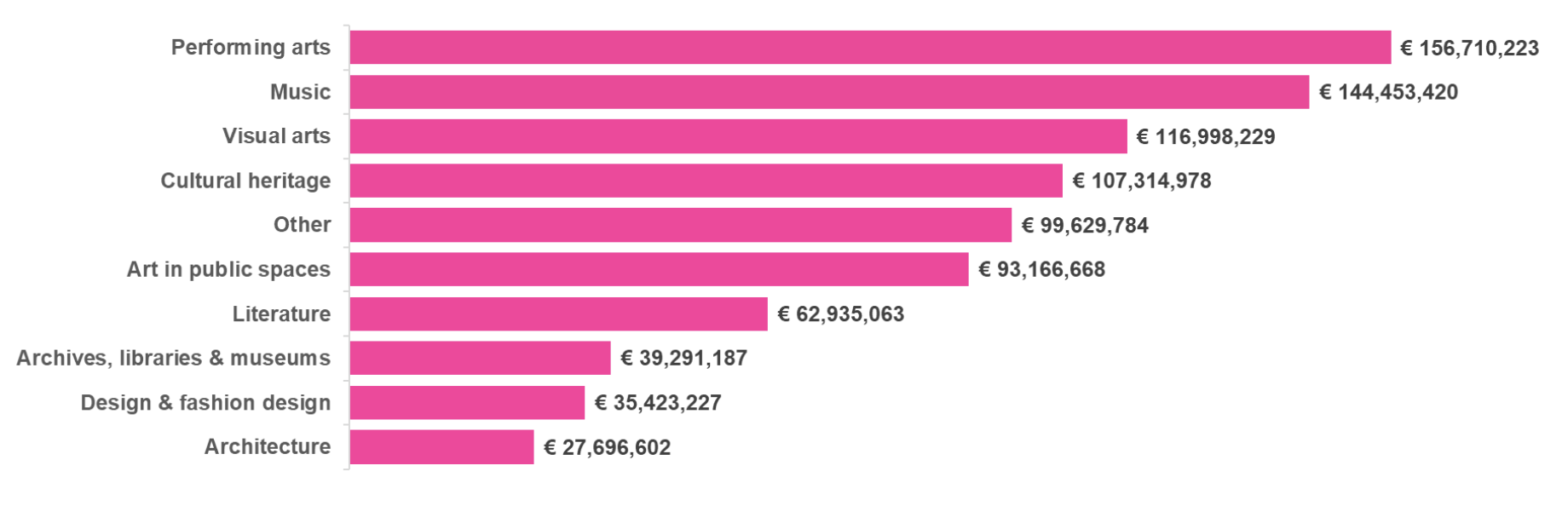
Graph: The total amount of funding awarded to sectors through the Culture Strand since 2014 in Euro. Source: Creative Europe dashboard.
In her post, Emma Rafowicz explains that her priorities are music and cinema, reading, independent bookstores and libraries, and a free and independent press. These sectors appear to matter to her because they reach citizens directly and shape public life. ‘AgoraEU is a vehicle to defend our democracy, our rule of law, and cultural diversity in Europe,’ she says. ‘Culture is what makes us European, and our cultural sovereignty should be protected.‘ This is a legitimate political priority, but it does not in itself explain why comparable structural attention is not given to other cultural sectors that also contribute to European democracy.
Second, several actions listed under the Music strand and the Books objective aren’t actually sector-specific: for example, support for European [music] networks, the mobility and exchange of artists and authors, and improved access to funding are cross-cutting needs that could just as well sit within the general pool. When cross-cutting needs are placed under sector-specific stands, access to them may become more uneven.
Third, we are also concerned about whether the current financial allocation to the Culture – Creative Europe strand is sufficient to address the needs and challenges of the cultural and creative sectors. By carving music out into its own strand, the Parliament has actually reduced the Culture – Creative Europe envelope down to €1.49 billion from the Commission’s €1.8 billion, even as the programme grows by 25%. And since the Music strand alone receives half of what the rest of the culture sector gets (€0.75 billion against €1.49 billion), the proposed balance between sectors looks off.
Culture Action Europe calls for an AgoraEU that covers all cultural and creative sectors fairly, protects the cross-sectoral nature of European cultural cooperation, and provides more ambitious funding for culture as a whole. Where sectors have specific needs, they must be addressed consistently, not selectively, across various sectors.
At the same time, this debate exposes a bigger gap: Europe’s cultural support infrastructure needs to be more diverse and dynamic. It must serve a wider range of cultural sectors and actors, and offer different tools for different points in the value chain — from mainstream to experimental culture, from creative industries to socially engaged arts. AgoraEU should be one instrument among several, not the whole of EU support for the cultural sector. Amid the push for simplification, we urge legislators not to lose sight of the sector’s specificities and diversity.
A further concern in the draft report is amendments 168-169, which reinstate the requirement that cultural organisations from non-associated third countries cover their own participation costs. This hinders international cultural cooperation and reduces non-EU organisations to the role of subcontractors rather than equal partners. Culture Action Europe calls for this provision to be removed and for organisations from non-associated third countries to be made eligible for AgoraEU funding where the project’s objectives require it.
It is also unclear to us whether the work programmes will be separate for each strand or whether there will be a single work programme for all of AgoraEU, which could affect the cultural sector’s autonomy and governance.
Culture Action Europe is working on the proposals for amendments for the Parliament’s draft report on AgoraEU.
Council’s position on AgoraEU
The Council of the EU (the body representing the governments of 27 Member States) adopted its position on AgoraEU on 12 May 2026. Not the final one: budget questions still need to go through finance and foreign affairs ministries, and the Council promises to make these decisions by the end of the year (a deadline most in Brussels consider ambitious). What’s on the table now is a partial general approach that concerns the content of the programme and leaves budgetary provisions bracketed […].
While Parliament proposes an ambitious and complex restructuring, the Council takes a more familiar approach. The Council’s position sticks fairly closely to the Commission’s proposal and preserves the Commission’s structure with three main strands: Creative Europe – Culture, MEDIA+, CERV+.
Here are the main changes the Council introduced:
- The definition of cultural and creative sectors is reintroduced, similar to the one in the current Creative Europe programme. The Culture strand covers all cultural and creative sectors except audiovisual and news media.
- The sectoral approach is reintroduced, but only for music, book publishing and libraries. Specific sectors are again singled out for promotion, though to a lesser extent than in the Parliament’s position (no dedicated strands, just a mention in the recitals).
- Article 4 details some objectives of the Culture strand. The Council explicitly names cooperation projects and partnerships, cultural education, discoverability, talent development, and support for market analysis capacities. This looks like an attempt to compensate for the absence of a detailed annex by writing key Creative Europe action types directly into the article. However, it doesn’t quite do the trick, since the level of detail is still insufficient.
- Regranting (i.e. financial support to third parties, for example, via cascading grants) is encouraged. The Council highlights that AgoraEU should be implemented through a ‘user-friendly application and reporting procedure.’ It also proposes impact, quality and relevance as key evaluation criteria for the project selection.
- On AgoraEU Desks, the Council states that the Programme should support the role and functioning of the Desks with adequate resourcing, and participating countries can choose how to manage them. How the Desks will be funded and structured, however, isn’t specified. ‘Participating countries should be able to choose the most appropriate way of managing such AgoraEU desks’ — does that mean they can keep Creative Europe Desks and CERV National Contact Points separate? Which strand will fund them?
- On participation of organisations from non-associated third countries in AgoraEU, the Council claims it can be funded only by way of exception, where their participation is ‘strictly necessary for implementing the action, contributes to AgoraEU objectives, and is in the Union’s interest.’ Sounds quite restrictive; however, bear in mind that the current Creative Europe Regulation states that organisations from third countries not associated to the Programme shall in principle bear the cost of their participation. For AgoraEU, the Council reintroduced this provision in earlier compromise texts, but it is absent from the partial general approach. This is a positive sign as the text no longer assumes that organisations from third countries must cover their own participation costs.
The Council’s version also contains good language about cultural rights and the intrinsic value of culture. Still, these amendments are mostly cosmetic and do not substantially change the programme’s objectives or procedures.
Several elements are missing from the Council’s text that Culture Action Europe would like to see: a clear annex with all funding lines, social conditionality, a dedicated objective for artistic freedom, digital fines redirected into AgoraEU, and a more coherent sectoral approach that goes beyond music, books and libraries.
The Council’s position offers a familiar structure and does not substantially rethink the programme. At the same time, it leaves AgoraEU’s potential untapped, particularly on issues of working conditions and artistic freedom, which the programme could at least help mitigate within its competence.
After the institutions adopt their positions, we expect trilogues (informal negotiations between the Commission, Parliament, and the Council to agree on a shared final version of an EU law before it is formally adopted).
For Culture Action Europe, the next phase of negotiations should preserve the strongest improvements introduced by Parliament (including artistic freedom, social conditionality, flexible funding, digital fines, etc.) while ensuring that the final structure remains balanced, inclusive and coherent for the whole cultural sector.